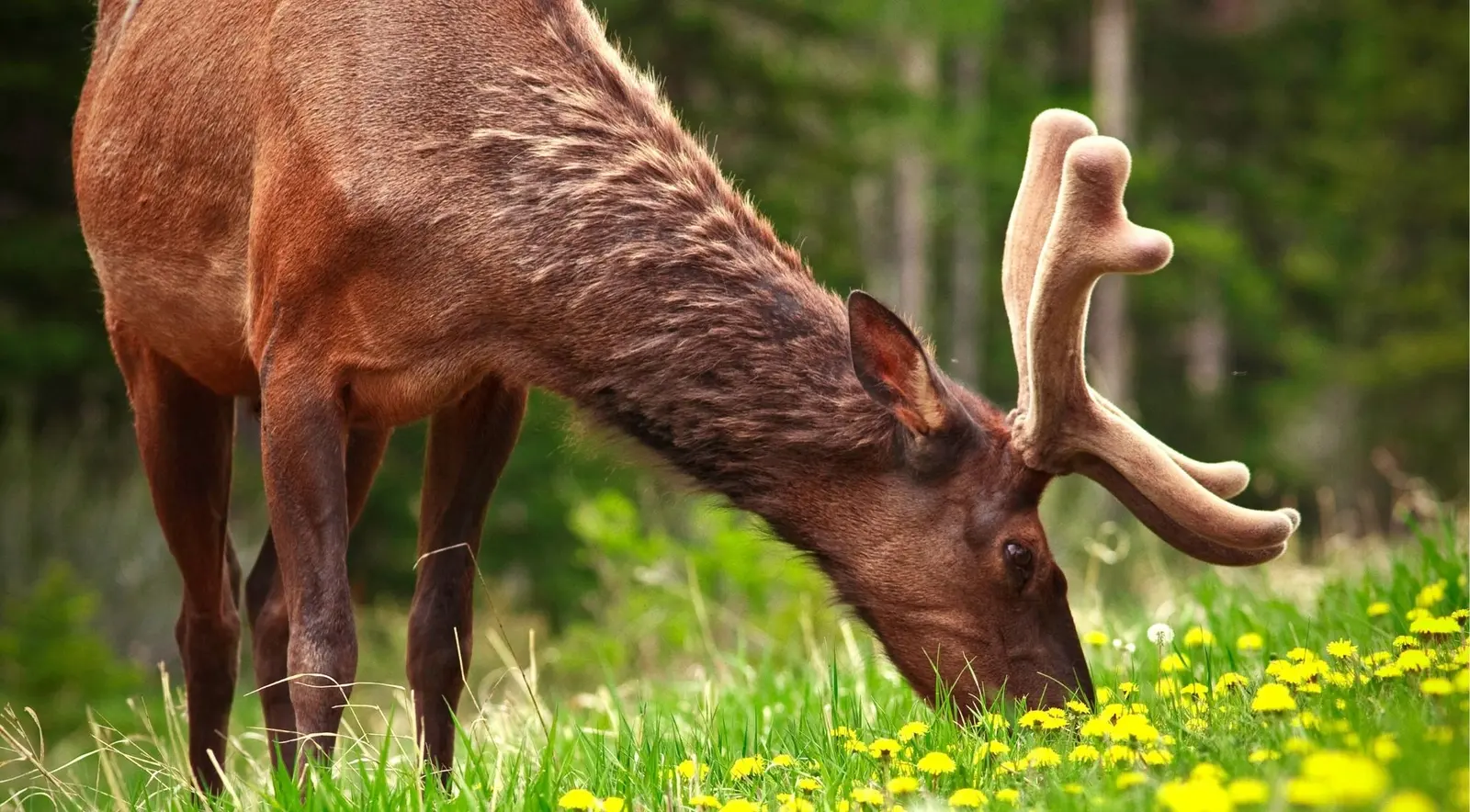
A bull elk grazing in a meadow in Banff National Park, the animal visitors see most often
Animals of Banff · a field guide · 2026

Animals of Banff: 20+ Species and Where to Find Them

Banff has 53 mammal species and more than 300 kinds of bird, but on a normal trip you will see a predictable handful: elk, bighorn sheep, deer, ground squirrels and, with luck, a bear. Here is how to identify each animal and where and when to look.

Bears, ungulates, small mammals and birdsWhere and when to look for each
  • 53Mammal species
  • 300+Bird species
  • ~65Grizzlies in the park
  • 30 m / 100 mElk and sheep / bears and wolves
  • Dawn & duskWhen animals move
The short answer

Elk and Sheep Most Days, Bears With Luck, Wolves Almost Never

Expect elk, bighorn sheep, mule deer and ground squirrels on most days in season, and black bears along the roadsides in spring and summer. Wolves, cougars, lynx and wolverines are almost never seen by ordinary visitors, however much they hope. Animals are most active at dawn and dusk, along a few reliable corridors: the Bow Valley Parkway, Vermilion Lakes, the Lake Minnewanka Loop, Mount Norquay Road and the Icefields Parkway.

Check live availability and prices on GetYourGuide. Pоwered by GetYourGuide.

The calendar above books the Banff Wildlife & Scenic Highlights Premium Tour (from $105, ★ 4.4 from 313 reviews on GetYourGuide). A guide drives the wildlife corridors where elk, sheep and deer feed, with stops at Bow Falls and Lake Minnewanka, so you spend the time looking instead of navigating.

Keep your distance; it's the law. Stay at least 30 metres from elk, deer, sheep, goats and moose, and 100 metres from bears, wolves, cougars and coyotes. For the species with their own guides on this site, you will find a short profile here and a link to the full page.

Your realistic odds

What You'll Actually See

  • Very commonly seen (in season): Columbian ground squirrel, elk, bighorn sheep, mule deer, red squirrel, Canada jay and ravens.
  • Often seen with some effort: black bear (roadsides), white-tailed deer, marmot and pika (alpine hikes), bald eagle and loons (Vermilion Lakes).
  • Lucky sightings: grizzly bear, moose, coyote and mountain goat.
  • Rare or almost never: wolf, cougar, lynx, wolverine and bison (in a remote valley), plus woodland caribou, which no longer live in the park at all.

Our best places to see wildlife guide covers the self-drive roads one by one.

Improve your odds

Other Experiences You Might Enjoy

Tours that go where and when the animals are.

A guide with a spotting scope makes the biggest difference for the animals that are hard to find alone: dawn and dusk wildlife safaris along the Bow Valley Parkway and the Lake Minnewanka Loop, guided bear-country hikes, the Banff Gondola up Sulphur Mountain for sheep and ground squirrels, and day trips up the Icefields Parkway toward mountain goat country. The live options below update automatically for experiences in and around Banff National Park.

Bears, wolves and cats

Large Carnivores

The animals people hope for, and how rarely most of them show.

Grizzly bear

Parks Canada estimates about 65 grizzlies in Banff. Identify one by the prominent shoulder hump, a dished (concave) face, short rounded ears and long, light front claws. Colour is no help, because they range from blonde to nearly black.

The park's famous bear is "The Boss" (Bear 122), a male in his mid-to-late twenties and one of the largest bears in the Bow Valley; Parks Canada weighed him at about 450 pounds at his last capture. He ranges widely, survived being hit by a train, and is usually among the first bears out of hibernation each spring. Look from your car along the Bow Valley Parkway and the Icefields Parkway. The top of the Lake Louise gondola also sits in prime grizzly habitat. Our bear watching guide and guide to seeing bears in Banff have the full picture.

Black bear

Smaller than a grizzly, with no shoulder hump, a straight "Roman" face, taller ears and short, curved claws for climbing. Despite the name, coats range from black to cinnamon. On all fours its rump is often the highest point, the opposite of a grizzly. Black bears favour the low forested valleys the roads run through, so visitors often see them eating roadside berries along the Bow Valley Parkway in spring and summer. The rule of thumb: grizzly = hump, black bear = rump. On foot, the bear-country wildlife guided hike (from $139, ★ 4.9 from only 14 reviews, so read the recent ones) teaches you to read bear sign safely.

Gray wolf

Wolves were wiped out in the park by the 1950s and returned on their own in the early 1980s. They look like a lanky, long-legged German shepherd with big feet and a broad muzzle, and most Banff wolves are dark. Packs are named for their territories and their numbers swing sharply: the Bow Valley pack collapsed in 2016 after animals became food-conditioned. Sightings are rare and brief; occasionally a wolf crosses the ice at Lake Minnewanka or moves along the Bow Valley Parkway in winter.

Cougar (mountain lion)

Canada's largest cat and Banff's stealthiest predator: tawny, long-tailed and muscular, preying on deer, elk and sheep. Even residents rarely see one, though tracks turn up in winter snow around Norquay and the Cave and Basin. Cougars are solitary, most active at dawn and dusk, and generally avoid people.

Canada lynx

A medium-sized wild cat with tufted ears, a short black-tipped tail, thick grey winter fur and huge, snowshoe-like paws for hunting on deep snow. It specialises in snowshoe hares, and its numbers rise and fall with the hare cycle. Lynx are nocturnal, solitary and elusive, and a sighting is rare and prized.

Wolverine

The largest member of the weasel family: a small, dark, bear-like animal with a reputation for toughness far beyond its size. A single wolverine may range over 3,000 square kilometres of high country. It is among the rarest animals in the park, and most visitors and locals will never see one.

Hoofed mammals

Elk, Sheep, Goats, Moose and Deer

The animals you are most likely to photograph, plus two conservation stories.

Elk (wapiti)

The park's most common and most visible large mammal, and the most dangerous to careless visitors. Look for a tan body, a pale rump and a dark neck; bulls grow branching antlers up to 1.2 m across, shed and regrown every year. Elk graze the valley meadows on the townsite outskirts, Vermilion Lakes Drive, the Banff Springs golf course road and the Bow Valley Parkway. The autumn rut (September to October) is spectacular, but rutting bulls and spring cows with calves are dangerous, so keep 30 metres back. Bow Valley elk numbers have fallen sharply in recent years, with predation and disease both cited. For the rut at golden hour, the Twilight Wildlife and Alpine Lakes sunset safari (from $139, ★ 4.5 from 68 reviews) adjusts its route to where animals are showing.

Bighorn sheep

The second most common hoofed mammal and Alberta's official mammal. Sandy brown with a white rump; rams carry massive spiralling brown horns that are never shed and grow for life, while ewes have short spiky ones. Reliable spots are the Lake Minnewanka Loop and Two Jack area, Mount Norquay Road and the top of Sulphur Mountain, reached by the Banff Gondola (★ 4.7 from 4,932 reviews). See our full bighorn sheep guide.

Mountain goat

Not a true goat but a goat-antelope, with a shaggy white coat, a beard and short, sharp black horns on both sexes, which tells it apart from a brown bighorn sheep. Goats are superb climbers that keep to the highest cliffs, which leaves few easy roadside spots; scan high along the Icefields Parkway. The Columbia Icefield, Skywalk, Crowfoot Glacier and lakes tour (from $77, ★ 4.7 from 964 reviews) drives that road. The famous mineral licks where goats gather lie north of the park, toward Jasper.

Moose

The largest deer, as tall as a horse, with long legs, a shoulder hump, a drooping muzzle and, on bulls, broad shovel-shaped antlers. Moose were once common at Vermilion Lakes but declined as elk numbers surged and competed for the same willow, and only a small number remain in the park. Your best odds are the wetlands on the Icefields Parkway near Waterfowl Lakes. Count any sighting as luck.

Mule deer

Named for their large, mule-like ears. Grey-brown with a white rump and a rope-like, black-tipped tail, they bound with a stiff-legged hop on all four feet. They are common all year near the Banff Centre and along Norquay Road, Vermilion Lakes Drive and the Bow Valley Parkway, and about twice as numerous as white-tailed deer.

White-tailed deer

Smaller and more slender, with a broad triangular tail, brown above and white below, raised like a flag when alarmed. Less common than mule deer, but seen along Vermilion Lakes Drive and the Bow Valley Parkway, especially in spring. Look at dawn and dusk.

Woodland caribou: a conservation story

Caribou once roamed northern Banff, but the park's last few animals died in a single avalanche near Molar Creek in April 2009. Caribou are now locally extinct here, and any return would need an active reintroduction, which has not happened as of 2026. You won't see caribou in Banff; their loss shows how fragile small populations are. Neighbouring Jasper still has a few, as our Banff vs Jasper wildlife comparison explains.

A note on bison

Plains bison returned in 2017 after well over a century's absence, when 16 animals from Elk Island National Park were released into the remote Panther Valley. The free-roaming herd had grown to more than 130 by 2024. They live in a backcountry zone that ordinary visitors effectively never see, but the project is one of Banff's great modern conservation successes.

Rodents, pikas and hares

Small Mammals

Hoary marmot

One of the park's largest rodents: a chunky, grizzled grey-and-white alpine animal nicknamed the "whistler" for its piercing alarm call. Marmots live in colonies in boulder fields, hibernate for much of the year and sun themselves on rocks on warm days. Look on higher hikes such as the Plain of Six Glaciers and Cascade Amphitheatre, and around the top of the gondola.

Pika

A tiny, round, short-eared relative of rabbits (not a rodent) that lives on talus slopes. It doesn't hibernate; instead it spends summer gathering "hay piles" for winter. It is well camouflaged; you usually find one by its sharp "eep." Reliable spots are the Moraine Lake rockslides and the far end of Lake Louise.

Ground squirrels

The Columbian ground squirrel is the mammal you will see most in summer: a tan, burrowing squirrel of meadows and lawns, and key prey for grizzlies, coyotes and eagles. The golden-mantled ground squirrel has a striped back and is often mistaken for a large chipmunk (chipmunks are smaller, with a stripe through the eye). Both are common at the Sulphur Mountain summit and at Moraine Lake's Rockpile.

Red squirrel

The park's noisy, territorial conifer specialist: reddish with a white belly and a big bushy tail, and quick to scold you with loud chattering. It is common throughout the subalpine forests.

Beaver

Canada's national animal and the largest rodent in the park, with webbed hind feet and a flat tail. Beavers fell trees and build the dams and lodges that many other species rely on, and they mate for life. Look at dawn and dusk around Vermilion Lakes and Johnson Lake: watch for lodges and listen for the warning tail-slap.

Porcupine and snowshoe hare

The porcupine is a large, slow, quill-covered rodent that climbs trees to eat bark and is notorious for gnawing salty gear in backcountry camps; it is common around Lake Louise. The snowshoe hare, with huge hind feet and a coat that turns white in winter, is the lynx's key prey and turns up along forest edges, especially in winter.

More than 300 species

Birds

Parks Canada counts more than 300 bird species in Banff. These are the ones visitors notice.

Bald and golden eagles

The bald eagle (white head and tail as an adult) hunts around lakes and rivers, and Vermilion Lakes is a noted spot. The golden eagle, a large dark raptor, passes through on one of North America's great raptor migrations along the eastern slopes of the Rockies.

Common loon

A large diving bird with a black head and a chequered back in summer, famous for its haunting, yodelling call. Loons nest on quiet, clear lakes, a sign of good water quality, and pairs are seen on the Vermilion Lakes.

Jays and nutcrackers

The Canada jay (whiskey jack, camp robber) is a soft grey, fearless subalpine bird that caches thousands of food items and nests in late winter. The Royal Canadian Geographical Society picked it as national bird in 2016, though Canada never officially adopted one. Clark's nutcracker is paler grey with black-and-white wings and a long bill, and is the main seed disperser for whitebark pine. The crested, deep-blue Steller's jay lives mainly west of the Divide. All of them are bold at viewpoints, but feeding them is illegal and harmful.

White-tailed ptarmigan

A small alpine grouse and a master of camouflage: mottled grey-brown in summer, pure white in winter. It stays above the treeline all year and is often nearly invisible; look on high hikes around Moraine Lake and the alpine passes.

Owls

The great horned owl is the large owl you are most likely to meet in Banff: big and ear-tufted, giving the classic deep hoot of the montane valleys. The boreal owl is small, secretive and strictly nocturnal, living in dense subalpine forest; you are most likely to hear one in late winter, when the male gives its rapid tooting song.

What each season brings

Banff's Animals by Season

  • Spring (April to June): bears come out of their dens, elk and deer have young, goats visit low licks and migrating birds return.
  • Summer (July to August): alpine species are active on the high trails, bears feed on berries and birds are nesting.
  • Fall (September to October): the elk and bighorn ruts, bears fattening up for winter and the raptor migration.
  • Winter: sheep move to lower elevations, wolves and coyotes are easier to spot against the snow, lynx and hares are active, and most bears are in their dens. The Banff wildlife and sightseeing minibus tour (from $63, ★ 4.6 from 159 reviews) runs in the colder months.

For the month-by-month breakdown, see our best time to visit Banff for wildlife guide. The Evening Wildlife Safari (★ 4.1 from 636 reviews) covers the dusk hours in any season it runs, and our getting around Banff guide shows which wildlife areas you can reach by bus.

The rules that keep animals alive

Watching Wildlife Responsibly

  • Keep the legal distances: 30 m from elk, deer, sheep, goats and moose; 100 m from bears, wolves, cougars and coyotes.
  • Carry bear spray and know how to use it, travel in groups and make noise on trails.
  • Never feed or bait wildlife. Fines reach $25,000, and fed animals often end up dead.
  • In a bear jam, stay in your car, put your hazard lights on and don't block the animal's path.
  • Use optics, not proximity. Binoculars and a zoom lens get the view without pushing the animal away.
  • Report large carnivores or aggressive animals to Banff Dispatch: 403-762-1470.

If you'd like to learn the bear-country basics with a guide, the guided nature walk with bear country safety tips (from $63, ★ 4.6 from only 7 reviews, so check recent feedback) covers them on an easy trail.

Common questions

Animals of Banff: FAQs

What visitors ask most about Banff's wildlife.

What animals live in Banff National Park?

Banff has 53 mammal species and more than 300 bird species, including grizzly and black bears, elk, bighorn sheep, mountain goats, moose, deer, wolves, cougars, lynx, marmots, pikas, beavers, eagles, loons and owls.

What animals are you most likely to see in Banff?

Elk, bighorn sheep, mule deer, Columbian ground squirrels and a range of birds are seen daily in season. Black bears are often seen by the roadside. Grizzlies, moose and coyotes are lucky sightings.

What animals are hardest to see?

Wolves, cougars, lynx and wolverines are almost never seen by visitors, and many locals go years without a sighting. Bison live in a remote backcountry zone and ordinary visitors don't see them at all.

Are there caribou in Banff?

No longer. Banff's last woodland caribou died in an avalanche in 2009, and the species is now locally extinct here. Any return would need an active reintroduction, which has not happened.

Where's the best place to see animals in Banff?

The Bow Valley Parkway, Vermilion Lakes, the Lake Minnewanka Loop and Mount Norquay Road, all at dawn or dusk. The Lake Louise gondola sits in prime grizzly habitat.

How do I tell a grizzly from a black bear?

Grizzlies have a shoulder hump, a dished face and long, light claws; black bears have no hump, a straight face and short, curved claws. Grizzly means hump, black bear means rump. Colour isn't reliable.

How close can I get to wildlife?

By law, no closer than 30 metres to elk, deer, sheep and moose, or 100 metres to bears, wolves and cougars. If the animal reacts to you, you're too close.

How many animal species are in Banff?

53 mammal species and more than 300 bird species, according to Parks Canada, across the montane, subalpine and alpine zones.

Be there at first light

See Them for Yourself

Knowing what lives here is half of it; the other half is being in the right place at first light. A guide with a spotting scope and local knowledge improves your odds on the harder-to-find animals.

  • Dawn and dusk departures, when animals are most active
  • Most wildlife tours include Banff hotel pickup
  • Free cancellation on most tours — book with confidence
Check Wildlife Tour Availability

We may earn a commission from bookings made through our links, at no extra cost to you. See our affiliate disclosure.