Late Mar–May: den emergence
Males first — The Boss is the reliable early riser; females with cubs last, into May. Food is scarce, so bears seek winter-killed carcasses and dig for roots and bulbs.
If you search "grizzly bear tour Banff," you'll find a well-reviewed, widely sold full-day tour that promises you'll see a grizzly. You almost certainly will — but the bear is Boo, a single orphaned male grizzly living in a 20-acre enclosure at Kicking Horse near Golden, BC, about two and a half hours' drive from Banff. It's a genuine rescue with a real story, and plenty of people come away moved. It is not wild bear viewing, and if you booked it expecting a grizzly on a mountainside, you'll feel misled. Here's what's actually on offer.
A full-day excursion into Yoho and on to Golden — typically Emerald Lake, Takakkaw Falls, the Golden Skybridge and a chairlift to the Kicking Horse Grizzly Bear Refuge to see Boo. Billed as the world's largest enclosed grizzly habitat, it's education-and-research rather than a zoo. Just know what you're buying: this is a captive bear.
Banff's grizzly density — roughly 8.7 bears per 1,000 km² — is one of the lowest in North America. There's no salmon-run-style food concentration to bring bears to a predictable spot, and a 100-metre legal distance rules out staged viewing. No operator can honestly promise a wild grizzly.
What operators do offer are wildlife safari drives that find bears opportunistically alongside elk, sheep and deer. They're worth booking — see our guide to Banff wildlife tours — just book them for the guiding, not for a bear guarantee.
For wild grizzlies at close range, fly to coastal BC during the salmon runs: Knight Inlet, Bella Coola, or the Khutzeymateen sanctuary near Prince Rupert. Coastal grizzlies eat salmon — higher densities, bigger bears, predictable congregations. A completely different experience from Banff.
The small-group safari that stacks the bear odds as well as a tour can: max 12 guests, panoramic windows, and a route re-planned daily on recent sightings through known bear corridors toward Lake Minnewanka and the Bow Valley. No one can promise bears — this gives you the best-informed chance.
Free cancellation on most tours. Secure booking via GetYourGuide.
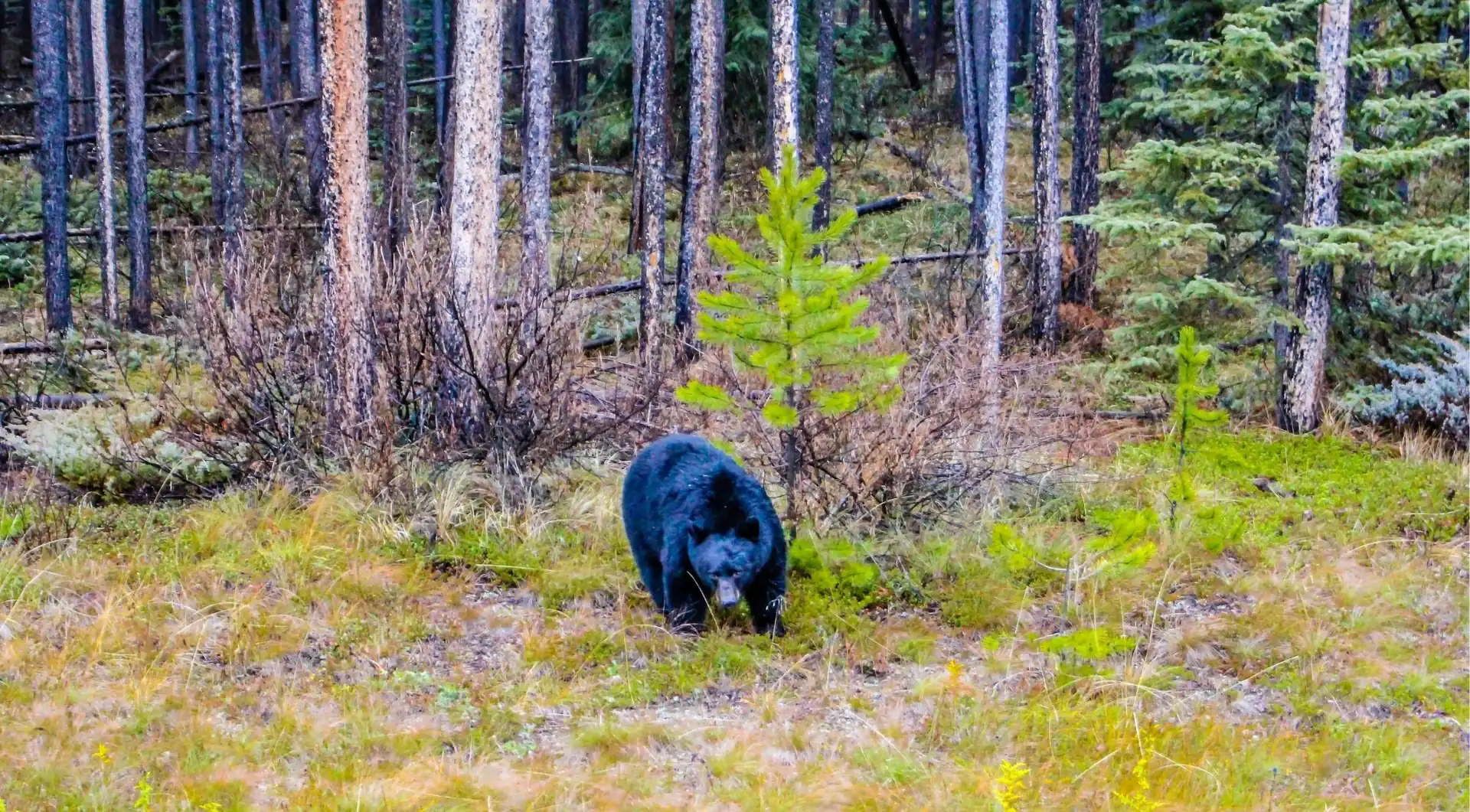
Colour is useless: around one in ten black bears here is cinnamon and gets reported as a grizzly constantly. Use structure instead.
| Grizzly bear | Black bear | |
|---|---|---|
| Population in Banff | ~65 park-wide (Parks Canada); ~70 per a 2025 study, stable to slightly increasing | More numerous; the bear most visitors actually see |
| Shoulder hump | Pronounced muscular hump — the highest point on the body | No hump; highest point is the rump |
| Face & ears | Concave "dished" face; short, round, wide-set ears | Straight, Roman-nosed profile; longer, prominent ears |
| Claws | 5–10 cm, straight — built for digging | 3–4 cm, curved — built for climbing |
| Where they favour | Open avalanche slopes, backcountry, spring roadside verges | Forested roadsides and valley bottoms — where you'll be |
The famous ones: Bear 122 "The Boss" (650–700 lb, mid-to-late twenties, a 2,500 km² range) survived a train strike and has sired most of the Bow Valley's cubs. His younger rival Bear 136 "Split Lip" is increasingly bold. And Bear 148 — relocated twice in 2017, then legally shot in BC — is the story that changed the conversation about how Banff manages its bears.
Bear country pairs naturally with the Rockies' headline scenery.
Bear watching is usually one part of a bigger trip. Travellers often combine a Banff wildlife safari with a drive up the Bow Valley Parkway and the Icefields Parkway toward the Columbia Icefield, a sunrise at Lake Louise and Moraine Lake, or a bear-country guided hike near Canmore and Kananaskis taking in Johnston Canyon and Lake Minnewanka. The live options below update automatically for these Canadian Rockies experiences.
Bears eat on a strict schedule dictated by a short mountain summer. Learn it and you can predict where they'll be.
Males first — The Boss is the reliable early riser; females with cubs last, into May. Food is scarce, so bears seek winter-killed carcasses and dig for roots and bulbs.
The best roadside viewing of the year. Verges green up first — sunny, low, snow-free — so bears risk human presence to reach the early flush. This is the whole reason for the Bow Valley Parkway's spring closure.
The single most important calorie source. Bears eat up to 200,000 berries a day (large males up to 300,000), feeding head-down for as much as 20 hours as hyperphagia sets in — and may not hear you coming.
Once frost takes the berries, bears switch to bearberry, pine nuts and ground squirrels. Females with cubs den first (mid-November); males stay up while food lasts, sometimes past Christmas.
A note on bad berry years: 2021 cut Banff's buffaloberry crop by around 80%, and 2022 repeated the shortage. In poor years bears range wider, are more food-stressed, and get into more conflict. For a full month-by-month plan, see our best time to visit Banff wildlife guide.
Black bears dominate forested roadsides and valley bottoms; grizzlies favour open avalanche slopes and the backcountry — and, in spring, green roadside verges.
The premier roadside bear route, especially the eastern montane section during spring green-up. Both species use it — The Boss and Split Lip included.
Long stretches of prime habitat, with the Saskatchewan Crossing area and Waterfowl Lakes particularly noted. Highway 93 South through Kootenay is good grizzly habitat too.
A recurring bear-jam hotspot with wildlife guardians often present, plus Vermilion Lakes and the lower Bow Valley near the townsite.
Sunshine Meadows, Healy Pass and the Panther and Spray drainages hold the highest density — but demand real effort and the greatest safety responsibility. For self-drive timing, see our wildlife tours guide.
A wildlife-focused guided hike through bear country in Banff and Kananaskis, with an experienced guide handling route choice, bear-safety and distance. The deeper, quieter alternative to a road safari for confident walkers.
Small-group hike. Secure booking via GetYourGuide.
Bear jams on the Bow Valley Parkway and Minnewanka loop have become extreme. A single multi-hour jam around The Boss on 24 July 2025 involved 1,422 vehicles, 66 cyclists and 84 people out of their cars; the next day Split Lip drew more than 300 vehicles in an hour. Social media has transformed this — a roadside bear is broadcast instantly, and the crowd arrives within minutes.
What you should do: slow down, stay in your vehicle, take your photograph through the window, and move on. Don't stop in a no-stopping zone, don't get out, and don't block the bear's escape route — particularly near the rail line, where a trapped bear can be killed by a train.
The legal minimum distance from a bear is 100 metres — about ten bus lengths — and it applies from inside your vehicle too.
The single most effective deterrent — research found it stops undesirable bear behaviour around 90% of the time. Carry it on a belt or chest holster where your dominant hand reaches it in seconds; buried in a pack it's decorative. Must be labelled for animal use and no larger than 500 ml. You cannot fly with it.
If you surprise a bear or it guards cubs, it's defensive: stay calm, back away, and if a grizzly makes contact, play dead. If a bear stalks you silently or attacks at night, it's predatory: do not play dead — fight back, targeting the face. Black-bear contact attacks are almost always predatory.
On trails, use your voice, keep dogs leashed or at home, and give feeding bears an enormous berth during buffaloberry season when they're head-down and may not register you.
Parks Canada uses warnings, advisories, restrictions and closures. Check the Banff bulletins and WildSmart reports before you travel; Banff Dispatch is 403-762-1470.
A gentle guided nature walk that doubles as a bear-country primer — how to read the landscape, use bear spray and behave around wildlife — before you head out on your own. A smart first outing for first-time visitors to the Rockies.
Hotel pickup available. Secure booking via GetYourGuide.
The bear questions travellers ask most before booking.
Only if the grizzly is captive. The widely sold "Discover Grizzly Bears" tour visits Boo, a rescued grizzly in an enclosure at Kicking Horse near Golden, BC, and effectively guarantees a sighting. No operator can guarantee a wild grizzly in Banff, and any that implies otherwise is overselling.
Two windows. Spring green-up, roughly May to mid-June, when bears feed on roadside verges — the best roadside viewing of the year. And buffaloberry season, mid-July to the end of August, when bears drop into valley bottoms to feed intensively.
For wild grizzlies at close range, coastal British Columbia during the salmon runs — Knight Inlet, Bella Coola or the Khutzeymateen. For an opportunistic wild sighting as part of a broader mountain trip, the Bow Valley Parkway and Icefields Parkway in Banff are as good as roadside viewing gets in the Rockies.
Around 65 grizzlies per Parks Canada, or approximately 70 per a 2025 peer-reviewed study. Black bears are more numerous and more frequently seen, though no precise park-wide figure is published.
If you're hiking, yes. If you're staying in your car on scenic drives it's not essential, but it's cheap insurance and you cannot fly with it, so rent or buy locally. Knowing how to deploy it matters more than owning it.
Slow down, stay inside, photograph through the window, and drive on. Don't stop in a no-stopping zone, don't get out, and don't linger — you may be blocking the bear's escape route.