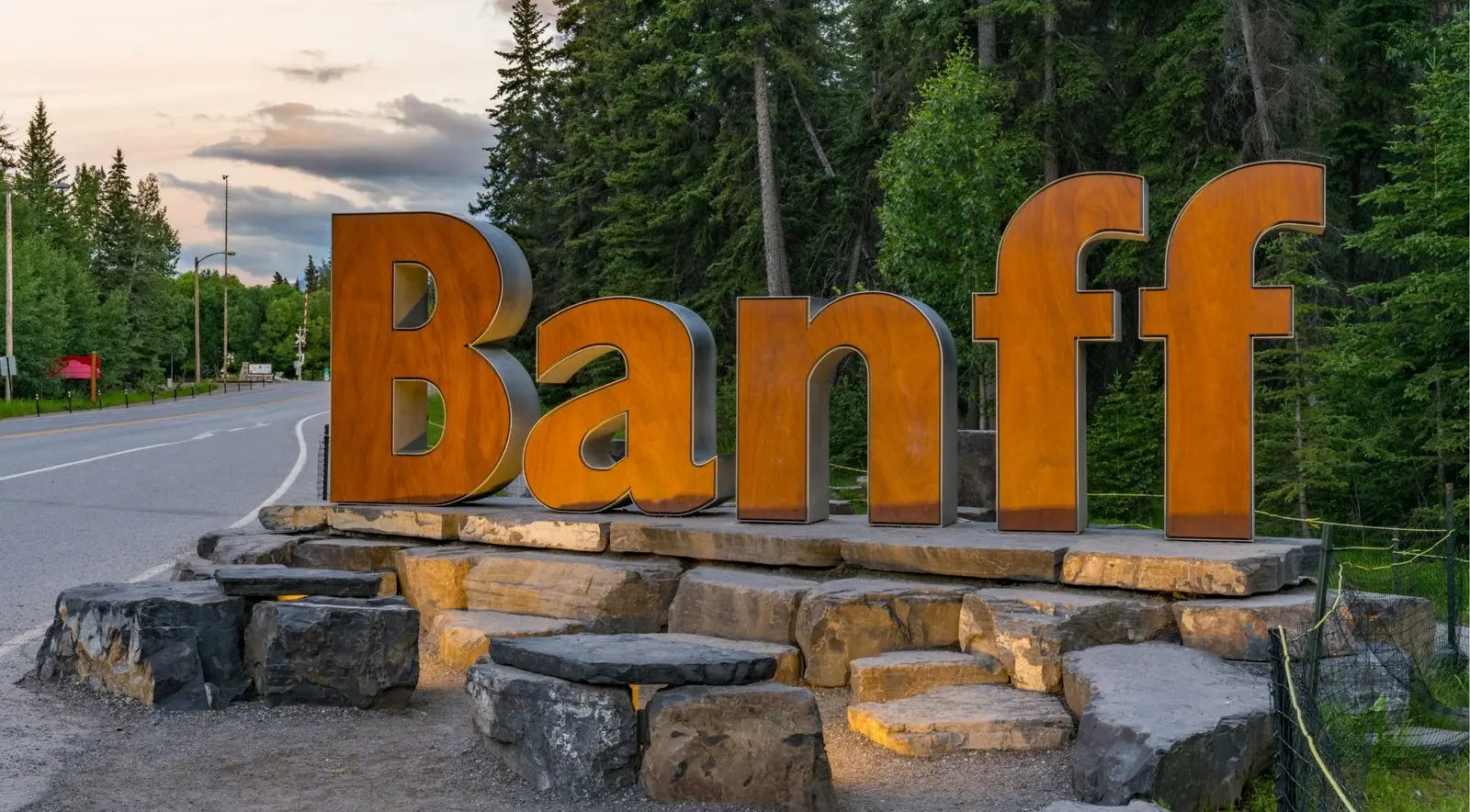
- 1885Hot Springs Reserve set aside
- 6,641 km²Size of the park today
- 1,383 mElevation of the town of Banff
- 53Mammal species, per Parks Canada
- 4.5 millionVisitors in fiscal 2025-26, a record
Canada's First National Park, Born From a Hot Spring
Banff National Park was set aside on November 25, 1885, as a small reserve around the Cave and Basin hot springs, and became Canada's first national park in 1887. Today it covers 6,641 km² of the Canadian Rockies in Alberta, about 110 to 180 km west of Calgary, and draws more visitors than any other Canadian national park. Some of the figures quoted about the park are disputed, and we flag those where they come up.
To see the living side of that history, the calendar above books the Banff Wildlife & Scenic Highlights Premium Tour (from $105, ★ 4.4 from 316 reviews on GetYourGuide). A guide drives the wildlife corridors around town and stops at Bow Falls and Lake Minnewanka, where a drowned resort village from the 1880s lies under the reservoir.
Banff National Park Key Facts
- Country and province: Canada, Alberta
- Established: 1885 as a reserve, 1887 as a national park, renamed Banff National Park in 1930
- Size: 6,641 km² (2,564 sq mi)
- Status: Canada's first national park
- Distance from Calgary: 110 to 180 km west, depending on which part of the park
- Highest peak: Mount Forbes, 3,612 m, the highest entirely inside the park
- Elevation of the town of Banff: 1,383 to 1,400 m, one of the highest towns in Canada
- Population of the town of Banff: 8,305 at the 2021 census; incorporated in 1990
- Wildlife: 53 mammal species, more than 300 birds and 844 plant species
- Visitors: a record 4.5 million in fiscal 2025-26, more than any other national park in Canada
- UNESCO: part of the Canadian Rocky Mountain Parks World Heritage Site since 1984
Getting there from the airport is covered in our Calgary to Banff guide.
Other Experiences You Might Enjoy
Tours that take in the places in this story.
Much of Banff's history is on the tour routes. The Banff Gondola climbs Sulphur Mountain, above the hot springs that started the park; boat cruises cross Lake Minnewanka, the Stoney Nakoda-named lake over a drowned resort village; and day trips up the Icefields Parkway reach the Columbia Icefield. Guided wildlife safaris on the Bow Valley Parkway pass the site of the Castle Mountain internment camp. The live options below update automatically for experiences in and around Banff National Park.
The Founding Story: How Banff Became a Park
Banff exists because of an accidental discovery. In November 1883, as the Canadian Pacific Railway pushed its transcontinental line through the Bow Valley, three railway workers, William McCardell, his brother Thomas and their friend Frank McCabe, found a steaming vent on the slopes of Sulphur Mountain near "Siding 29". Using a felled tree as a ladder, William climbed down into a misty cavern and found a pool of warm mineral water. In the 19th century a natural hot spring was a remarkable commercial opportunity.
The men tried to stake a claim, but competing claims led to a legal tangle. Instead of letting the springs fall into private hands, the government of Sir John A. Macdonald stepped in. On November 25, 1885, an order-in-council set aside 26 km² around the Cave and Basin as the Banff Hot Springs Reserve, the beginning of Canada's national park system.
Two years later the Rocky Mountains Park Act of June 23, 1887, expanded the protected area to 674 km² and named it Rocky Mountains Park, Canada's first national park. It was renamed Banff National Park in 1930.
Why Is It Called Banff?
The name has nothing to do with the local landscape. The CPR station at Siding 29 was renamed after Banffshire in Scotland, the birthplace of CPR president George Stephen, later Lord Mount Stephen. The railway often gave its stations names inspired by Banffshire.
The Railway and the Castle in the Rockies
The CPR did more than trigger the park's creation; it built its tourism economy too. General manager William Cornelius Van Horne championed a chain of grand railway hotels, and his signature project, the Banff Springs Hotel, opened in 1888 and was billed as the largest hotel in the world. Marketed as the "Castle in the Rockies", the Scottish Baronial building, largely rebuilt after a fire in 1926, operates today as the Fairmont Banff Springs. If you want to sleep there, it is one of the hotels in our where to stay in Banff guide.
Geography and Geology
Banff sits on the eastern slopes of the Continental Divide, which forms its western boundary. The mountains are sedimentary rock, limestone, dolomite, shale, sandstone and quartzite, laid down in ancient seas between roughly 600 and 175 million years ago and then thrust upward during the Laramide mountain-building event, 80 to 55 million years ago. Over the past few million years, glaciers carved the U-shaped valleys and sharp horns that give the Rockies their profile.
The park includes part of the Columbia Icefield, the largest mass of glacial ice in the Rockies, and the Bow River flows through the townsite. By elevation Banff has three ecoregions: the montane, the warm valley bottoms that are richest in wildlife; the subalpine, with its dense forests; and the alpine, above the treeline at about 2,300 m. The Columbia Icefield, Skywalk, Crowfoot Glacier and Lakes Tour (from $77, ★ 4.7 from 983 reviews) takes you to the glaciers, and our Icefields Parkway guide covers the drive.
Why Banff's Lakes Are So Blue
It is one of the questions visitors ask most. The lakes glow turquoise because of rock flour, glacial silt so fine that it stays suspended in the meltwater and scatters sunlight into that blue-green colour. Lake Louise was renamed in 1884 for Princess Louise Caroline Alberta, a daughter of Queen Victoria, and the province of Alberta is named after her too.
To see the colour at its best, the Moraine Lake Sunrise & Lake Louise Golden Hour Experience (from $100, ★ 4.7 from 508 reviews) reaches both lakes early. See our Moraine Lake guide and our best photography spots in Banff.
UNESCO World Heritage Status
In 1984 UNESCO inscribed the Canadian Rocky Mountain Parks, Banff, Jasper, Kootenay and Yoho plus three British Columbia provincial parks, as a World Heritage Site, both for their exceptional natural beauty and for their record of Earth's history. That record includes the Burgess Shale in Yoho, one of the world's most important fossil sites, which preserves soft-bodied sea creatures from about 508 million years ago.
Indigenous History
Long before the railway, this land had been home to Indigenous peoples for more than 10,000 years; evidence at Vermilion Lakes dates human presence to roughly 10,300 years ago. The region lies within the traditional territories of many nations, including the Stoney Nakoda, Blackfoot, Tsuut'ina, Ktunaxa and Plains Cree, who held the hot springs sacred as healing waters. Many features still carry Stoney Nakoda names, Lake Minnewanka among them.
This history has a painful side: between roughly 1890 and 1920 the Stoney Nakoda were largely shut out of the new park. Today Parks Canada works with First Nations to bring Indigenous knowledge into how the park is looked after.
A Darker Chapter: First World War Internment
During the First World War, Canada interned thousands of people it classed as "enemy aliens" under the War Measures Act, 8,579 across the country according to Parks Canada. In Banff the camp opened at Castle Mountain in July 1915 and moved to the Cave and Basin for the winter that November; it closed in July 1917. Its civilian prisoners, most of them Ukrainian immigrants, were made to do hard labour building the park's roads and infrastructure. Published counts of how many were held at Castle Mountain differ, so we don't give one here. A memorial and an interpretive exhibit at the Cave and Basin now commemorate them, and our Bow Valley Parkway guide covers the Castle Mountain site.
Banff History Timeline
- More than 10,000 years ago: Indigenous peoples present in the Bow Valley
- 1883: CPR workers discover the Cave and Basin hot springs
- 1885 (November 25): Banff Hot Springs Reserve established, 26 km²
- 1887 (June 23): Rocky Mountains Park Act creates Canada's first national park
- 1888: Banff Springs Hotel opens
- 1902: park expanded to 11,400 km²
- 1915 to 1917: Castle Mountain internment camp operates
- 1930: National Parks Act renames it Banff National Park
- 1984: UNESCO World Heritage inscription
- 1990 (January 1): Town of Banff incorporated
- 1997: buffalo paddock removed to restore wildlife movement
- 2017: plains bison reintroduced to the backcountry
- 2025-26: a record 4.5 million visitors
The Town of Banff: A Town Inside a National Park
Banff is one of only two incorporated municipalities inside a Canadian national park; the other is Jasper. It was incorporated on January 1, 1990. Because the land is inside a federal park, there is no freehold land: the town leases it from the federal government, and its boundaries are fixed by law and cannot grow.
A "need to reside" rule requires residents to show they work in the park, or depend on someone who does, and a population cap of about 10,000 applies; the 2021 census counted 8,305 permanent residents. At 1,383 m, Banff is often called the highest town in Canada. The residency rule is also why you can't rent an Airbnb in the town; see our where to stay in Banff guide for what to book instead.
Banff Wildlife Facts
Parks Canada records 53 mammal species, over 300 birds, 844 plant species, 19 fish, 4 amphibians and 1 reptile in Banff. The best-known mammals include grizzly and black bears, wolves, cougars, wolverines, elk, moose, bighorn sheep and mountain goats. Our animals of Banff guide is the full field guide.
The wildlife crossings. Banff has the most extensive wildlife-crossing system on Earth: 44 structures, 6 overpasses and 38 underpasses, along the twinned Trans-Canada Highway, with 82 km of highway fencing. Together they have cut wildlife-vehicle collisions by more than 80%, and Parks Canada had counted more than 150,000 crossings since 1996 by 2012. See our wildlife crossings guide.
The bison return. On February 1, 2017, Parks Canada brought 16 plains bison back to the Panther Valley after more than a century's absence. The free-roaming backcountry herd has since grown to more than 130 animals, one of the park's great modern conservation successes.
The Banff Springs snail (Physella johnsoni). No bigger than an apple seed, this endangered snail lives only in the thermal springs of Sulphur Mountain and nowhere else on Earth. It was the first mollusc to be listed as endangered federally.
Conservation History
Banff's story is a slow turn from exploitation to protection. It began as a commercial spa, and for decades the park made room for coal mining, a buffalo display paddock, an airstrip and a zoo. The turning point came in the 1990s, when the Banff-Bow Valley Study found the park's ecological integrity seriously compromised. That led to the removal of the buffalo paddock in 1997, and of the airstrip, to let wildlife move freely again.
The Canada National Parks Act of 2000 made ecological integrity the first priority of Canada's national parks, setting Parks Canada's dual mandate of protection and enjoyment with protection first. The bison reintroduction is the flagship of that approach.
Tourism and the Pressure of Success
Banff is Canada's most-visited national park, with a record 4.5 million visitors in fiscal 2025-26. Roughly 70% of visits are day trips from the Calgary region, and the pressure falls on a few hotspots: the Lake Louise and Moraine Lake area alone draws about 2.6 million visitors a year, which has led Parks Canada to restrict private vehicles at Moraine Lake and run large shuttle and transit services. That is the central tension of modern Banff, keeping up with its popularity while meeting the legal duty to protect the ecosystem. Our Banff itineraries and getting around Banff guides help you plan a visit that goes easy on the park.
Interesting and Fun Facts About Banff
- Birthplace of a system: the Cave and Basin is the birthplace of Canada's whole national park network.
- The ghost bride: the Fairmont Banff Springs is famous for its ghost stories, a "ghost bride", "Sam the Bellman" and the legendary sealed Room 873, which the hotel treats as much-loved folklore.
- A festival of mountains: the Banff Centre Mountain Film and Book Festival, launched in 1976, runs the largest adventure film tour on the planet, reaching more than 45 countries.
- Named for a princess: both Lake Louise and the province of Alberta honour Princess Louise Caroline Alberta.
- Trails: more than 1,600 km of trails wind through the park.
- A snail found nowhere else: the Banff Springs snail is a true Banff endemic.
- A view of the springs from above: the Banff Gondola (★ 4.7 from 4,960 reviews) rides up Sulphur Mountain, the same mountain whose hot springs started it all.
Banff History and Facts: FAQs
The questions visitors ask most about the park's past and its numbers.
When was Banff National Park established?
As a reserve on November 25, 1885, and formally as Canada's first national park under the Rocky Mountains Park Act on June 23, 1887. It was renamed Banff National Park in 1930.
How big is Banff National Park?
6,641 square kilometres, or 2,564 square miles. It was larger in the past, 11,400 km² in 1902, before later boundary reductions.
Is Banff the oldest national park in the world?
No. It is Canada's first national park, dating from 1885, but Yellowstone in the United States, established in 1872, and others are older. The popular claim that Banff is the world's third national park is disputed, so we don't repeat it.
What is the highest mountain in Banff?
Mount Forbes, at 3,612 m, is the highest peak entirely inside the park. Mount Assiniboine, at 3,618 m, is higher but sits on the British Columbia border.
How many people visit Banff each year?
A record 4.5 million in fiscal 2025-26, which makes it Canada's most-visited national park. About 70% of visits are day trips from the Calgary area.
Why is it called Banff?
After Banffshire in Scotland, the birthplace of Canadian Pacific Railway president George Stephen. The railway named its station after it, and the name stuck.
Why are Banff's lakes so blue?
Rock flour, fine glacial silt held in the meltwater, scatters sunlight and gives the lakes their turquoise colour. The effect is strongest in summer, when the glaciers are melting.
How many animals live in Banff?
Parks Canada records 53 mammal species and over 300 birds, along with 844 plant species, from grizzly bears and wolves to the tiny Banff Springs snail, which lives nowhere else.