- 30 mMinimum distance, about 3 bus lengths
- Late SeptRut at its height into early October
- Mid-MayCalving starts, to early July
- Up to 450 kgA big bull, per Parks Canada
- 403-762-1470Banff dispatch, to report elk
Come in Autumn for the Rut, and Give Every Elk 30 Metres
You can see elk in Banff in every season, most easily at dawn and dusk on the edges of town, at Vermilion Lakes and along the Bow Valley Parkway. The most dramatic time is the autumn rut, when bulls bugle and fight right in and around the townsite, peaking from late September into early October. Stay at least 30 metres away from any elk, which Parks Canada puts at about three bus lengths, and further during the rut and the spring calving season. This guide covers the animal itself, the rut and calving seasons, the long story of elk in the town, where and when to look, and the safety rules to read before you go.
To watch elk with someone who knows the herd, the calendar above books the Banff Wildlife & Scenic Highlights Premium Tour (from $105, ★ 4.4 from 316 reviews on GetYourGuide). A guide drives the wildlife corridors where elk, sheep and deer feed and re-routes on recent sightings, with stops at Bow Falls and Lake Minnewanka, and keeps the group at a safe distance when a bull is on the road.
What Is an Elk?
The elk, or wapiti (Cervus canadensis), is one of the largest members of the deer family, and after the moose the second-largest deer in Banff.
The name is famously muddled. Early European settlers thought this big North American deer looked like the animal they called an elk back home, and the name stuck, so in Europe "elk" still means moose. To avoid the confusion, biologists and Indigenous peoples use wapiti, a Shawnee and Cree word meaning "white rump", after the animal's pale cream rump patch. Banff's elk are the Rocky Mountain subspecies.
Other Experiences You Might Enjoy
Wildlife tours where elk are a regular sighting.
Most guided wildlife safaris in Banff work the same elk ground: the Bow Valley Parkway, Vermilion Lakes, the Lake Minnewanka Loop and the meadows around the Banff Springs golf course, often with bighorn sheep, deer and, in spring, black bears along the way. Dusk evening safaris catch elk at their most active, and a minibus tour adds the town's sights. The live options below update automatically for experiences in and around Banff National Park.
The Animal Itself
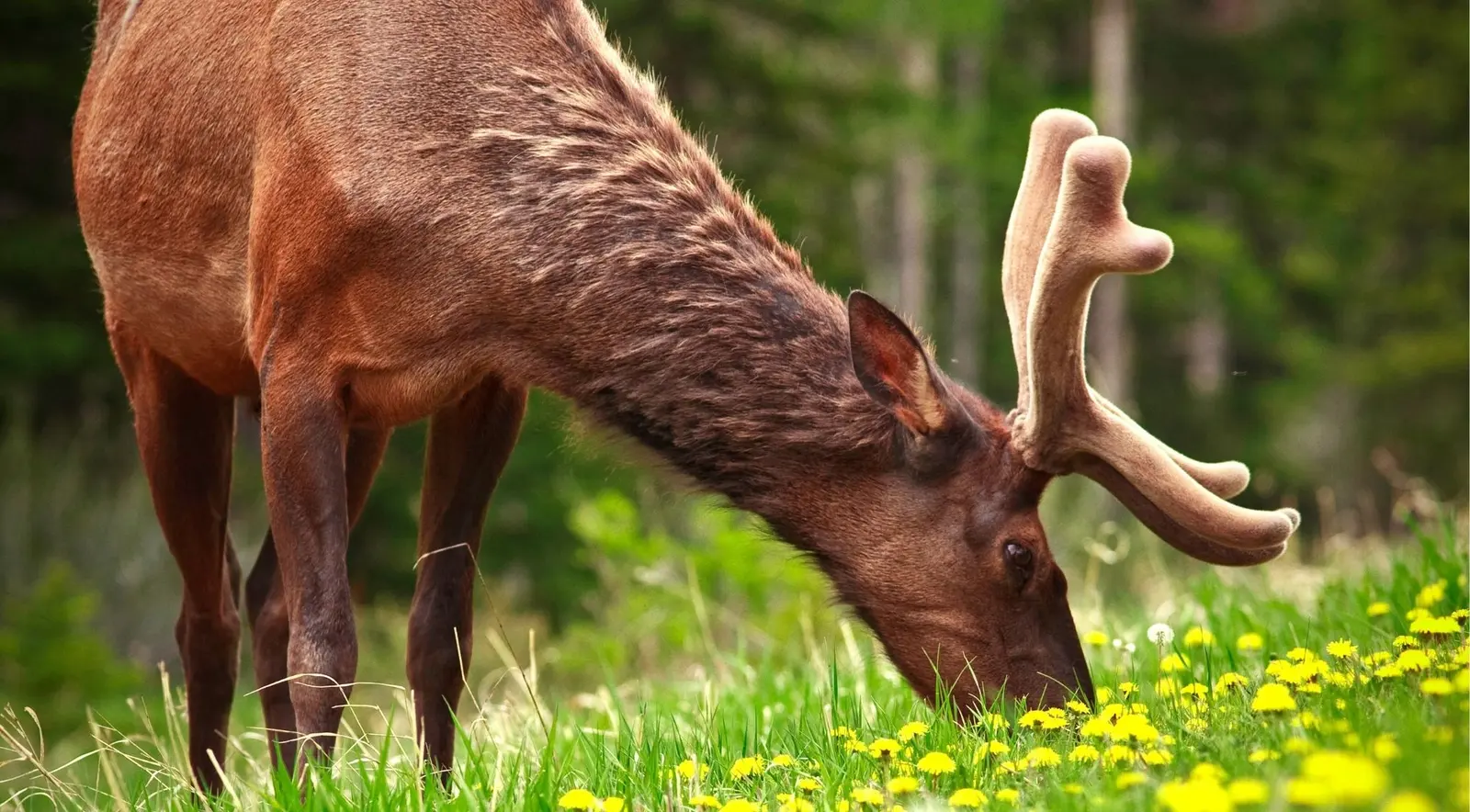
Elk are light to reddish brown, with darker faces, necks and legs and that creamy rump. Bulls grow a shaggy dark mane on the neck, thickest in winter. Adults stand roughly 1.3 to 1.5 m at the shoulder. A mature bull usually weighs 300 to 450 kg and a cow around 225 kg, although figures vary by source; Parks Canada gives bulls up to 450 kg.
The antlers are the headline feature. Only bulls grow them, and they are shed and regrown every year. New antlers start growing in spring, covered in a living, blood-rich skin called velvet that lays down bone at up to an inch a day, among the fastest bone growth of any mammal. By late summer they harden, the bull rubs off the velvet, and he enters the rut with a polished rack that can reach about 1.2 m and weigh up to 18 kg a pair; Parks Canada records racks of up to 22 kg. A mature "6x6" bull carries six tines on each side. Antlers drop in late winter, the biggest bulls first, and start regrowing straight away.
Elk vs Deer vs Moose
Visitors often mistake elk for mule deer, and now and then for moose:
- Size: an elk is far larger than a mule deer or white-tailed deer, but clearly smaller than a moose.
- Rump and tail: elk have a large cream rump and a short, stubby tail; mule deer have a smaller white rump and a thin, rope-like tail with a black tip.
- Neck: elk have a thick dark neck, with a mane on the bulls.
- Moose: much bigger and nearly black, with a bulbous overhanging nose, a flap of skin under the throat called a bell, and broad, flat, shovel-shaped antlers, nothing like a bull elk's branching tines.
- Voice: the bugle gives an elk away. Nothing else in Banff makes that sound.
For the full species roundup, see our animals of Banff guide.
The Elk Rut in Banff
The autumn breeding season runs from roughly late August or September to mid-October, and is at its height from late September into early October. It is one of the most dramatic wildlife spectacles in the Rockies, and it happens right in and around the town.
Bugling. The bull's bugle is the sound of a Banff autumn: a low bellow that rises to a high, screaming whistle and ends in grunts or "chuckles". It carries for miles. Bulls bugle to advertise their fitness, draw cows into a harem and challenge rivals.
Harems and fights. Mature bulls gather groups of cows, commonly a dozen or more, and defend them fiercely. They posture, thrash brush with their antlers and spar; if neither backs down, they lock antlers and wrestle, which occasionally causes serious injury. Young "satellite" bulls hang around the edges trying to steal cows.
Wallowing and scent. A rutting bull wallows in mud, sprays himself with urine and rubs his antlers through the vegetation to smell stronger and look bigger, and you will smell it as well as see it. A bull holding a harem barely eats and can lose up to 20% of his body weight, so he goes into winter run down.
Danger. Bulls full of testosterone are unpredictable and genuinely dangerous. Parks Canada's annual rut advisory warns that bulls become extremely aggressive protecting their harems: keep at least 30 m away, never get between a bull and his cows, and never park between them, because bulls charge and damage cars. In 2017 a bull was destroyed after attacking a jogger at the Banff recreation grounds. Each fall the town even takes down playground swings so bulls don't get their antlers tangled in them.
Where it happens: the Banff Springs golf course loop, Central Park and the Bow River meadows, the park administration grounds, and the roadsides around town.
Calving Season: The Other Danger Window
From mid-May to early July, cows leave the herd to give birth to a single spotted calf in a secluded thicket. For its first few weeks the calf is almost defenceless, so the cow hides it in tall grass, licks it clean of scent, and comes back only a few times a day to nurse, standing guard nearby.
That makes cow elk extremely dangerous in late spring. A defensive mother will charge, strike with her sharp front hooves and attack from behind, often before a person realises there is a calf nearby. Parks Canada's advice is blunt: if you see a lone female, assume there is a calf you can't see and give her a wide berth. Incidents happen every spring. Cows have charged hikers and cyclists near Surprise Corner, and a man was kicked in the head in Banff. Each spring Parks Canada closes the west slopes of Tunnel Mountain, an important calving ground, to give cows somewhere secure to have their calves.
The Story of Banff's Town Elk
Banff's most important elk story is about people and elk colliding. Elk numbers in the park were very low by the early 1900s, and Parks Canada brought in 235 elk from Yellowstone in 1918 to 1920. Through the 20th century the herd grew, to more than 1,000 in the valley, as elk learned that the town was effectively free of predators. They gathered on lawns, the golf course and the playing fields.
By the late 1990s an estimated 500 elk lived in and around Banff, and the conflict was severe: incidents needing medical attention rose from 42 in 1993 to 107 in 1998. In 1999 Parks Canada launched an elk management strategy with two goals, to restore the natural ecology and to reduce conflict.
The results were dramatic. Between 1999 and 2002, 212 habituated town elk were trapped and moved out of the Bow Valley, and two were put down. Parks Canada then used aversive conditioning, with noisemakers, rubber bullets and even herding dogs, to make the remaining herd wary of people again. Aggressive-elk incidents fell from 106 in 1999 to 19 in 2003, and the willows began to recover. Parks Canada still patrols for elk in town and hazes them out to keep people and elk apart.
Where and When to See Elk in Banff
As Parks Canada puts it, if there is one large animal you are "almost guaranteed to see" in Banff, it is the elk. The best places to look:
- The Banff Springs golf course loop: one of the most reliable spots, especially during the rut.
- Vermilion Lakes Drive and the Fenland Trail: marsh and meadow on the edge of town.
- The banks of the Bow River near the Banff Avenue bridge and in Central Park.
- The Bow Valley Parkway (Highway 1A): the classic wildlife road. See our Bow Falls and Bow Valley Parkway guide for its spring and autumn closures.
- Lake Minnewanka Road and Cascade Ponds: herds gather here in fall and winter.
Timing: elk are most active at dawn and dusk, and the autumn rut is the best time of year to watch them. In winter they move down to the valley bottoms and gather near town, easy to spot against the snow (our guide to wildlife in Banff in winter covers the other species out then); in summer many spread out to higher ground. See our best time to visit Banff for wildlife guide for the month-by-month calendar, and our best places to see wildlife in Banff for the roads in more detail.
A guide takes the guesswork out of finding them. The Evening Wildlife Safari (★ 4.0 from 642 reviews) is out at dusk, when elk are most active; it is the most-reviewed wildlife tour in Banff, though its reviews are more mixed than most, so read the recent ones. The Banff wildlife and sightseeing minibus tour (from $63, ★ 4.6 from 159 reviews) is the higher-rated and cheaper option, and mixes the elk meadows with the town's sights.
Elk Safety in Banff
Elk are the animal most likely to injure people in the Bow Valley; one local expert has called them "the most dangerous animal in Alberta, by far". They can attack without warning in any season, and grazing on a lawn does not make them tame.
- Keep at least 30 metres away, about three bus lengths, and more during the rut and calving. Some experts suggest 60 to 100 m.
- Watch for the warning signs: if an elk becomes alert, grinds its teeth, curls its lip or lays its ears back, you are too close. Back off.
- In the fall rut: never get between a bull and his cows, and don't park between them. Walk in groups, and detour around elk on the uphill side.
- In the spring calving season: never come between a cow and her calf, assume a lone female has a hidden calf nearby, and remember that cows attack from behind.
- Dogs: keep them on a leash at all times. To an elk, an off-leash dog looks like a wolf and can set off a charge.
- If an elk comes too close: act dominant. Raise your arms or a jacket to look bigger, keep eye contact, and never turn your back or run. Put a tree, rock or vehicle between you and the elk, and back away slowly.
- If you are knocked down: get up and get to cover. Do not play dead; the advice for bears is different.
- On the roads: Parks Canada says about 70 elk die in collisions with cars or trains in the park each year. Slow down at dawn and dusk.
- Photographers: getting too close for a picture is the most common reason for a charge. Use a long lens; our best photography spots guide covers where to shoot from.
Report aggressive elk, or any elk inside the town, to Banff dispatch on 403-762-1470.
Ecology and Behaviour
Elk both graze and browse: grasses, sedges and wildflowers in summer, and dried grasses, twigs and bark in winter, about 9 kg of plants a day. Outside the rut the sexes live apart. Cows, calves and young bulls form nursery herds, while mature bulls live alone or in bachelor groups. Elk are the most vocal of the deer. Besides the bugle, they use squeals, chirps and mews to keep in touch, and bark to warn of danger.
They are partial migrants: some move high in summer and down to the valleys in winter, while others stay put. Their predators are wolves (the main predator of adults), cougars and bears, which kill a large share of the calves. In the wild an elk lives roughly 10 to 13 years.
Elk and the Ecosystem
Elk are the keystone plant-eater of the Bow Valley and the main prey of its wolves; the Bow Valley pack depends heavily on them. When predators were kept out and elk sheltered in town, an overgrown herd ate down the aspen and willow. Letting wolves back into the valley, through wildlife corridors and crossing structures, was central to Parks Canada's strategy. Our Banff wildlife crossings guide explains how those connections work.
Banff is also part of the "ecology of fear" debate, the idea from Yellowstone that fear of wolves changes where elk feed and lets the plants recover. Scientists still dispute it. What can be said is that wolves, cougars and bears together, by killing elk and by changing how they behave, help keep elk numbers and browsing in check, but the exact mechanism is still argued over.
How Many Elk Are in Banff?
Elk are not endangered: they are abundant across North America. In Banff the question is the local balance. Parks Canada's fall count of the lower Bow Valley herd, from Castle Mountain to the park's east gate, fell from 267 elk in 2018 to 123 in 2024, a drop of roughly 54%, which put it below Parks Canada's target of 150 to 300 animals. Parks Canada cautions that each count is a snapshot of one season, not a trend on its own.
The decline is put down to wolf and cougar predation, a bacterial disease linked to a liver-fluke parasite, deaths on the railway and highway, and changing habitat as meadows that no longer burn fill in with trees. Parks Canada uses prescribed burns to open them up again.
Elk in Banff: FAQs
What visitors ask most about Banff's elk.
When is the elk rut in Banff?
Rutting behaviour can start in late August and run to mid-October. It is at its height from late September into early October. That is when bulls bugle, gather harems and fight: the best time to see and hear elk, and also the most dangerous.
Where can I see elk in Banff?
On the Banff Springs golf course loop, at Vermilion Lakes and along the Fenland Trail, by the Bow River near town, on the Bow Valley Parkway and on Lake Minnewanka Road. Dawn and dusk are best.
Are elk dangerous?
Yes. Elk injure more people in the Bow Valley than any other animal. Rutting bulls in the fall and cows with calves in the spring are especially aggressive. Keep at least 30 metres away, and more in those seasons.
What's the difference between an elk and a moose?
An elk is smaller and reddish brown, with a pale rump and branching antlers with tines. A moose is much bigger and nearly black, with a bulbous nose, a flap of skin under the throat called a bell, and broad, flat, shovel-shaped antlers.
What is bugling?
Bugling is the bull elk's mating call: a low bellow that rises to a high scream and ends in grunts. Bulls bugle to attract cows and challenge rivals, and the sound carries for miles.
What do I do if an elk charges me?
Don't run or turn your back. Make yourself look big, keep eye contact, and put a tree, rock or vehicle between you and the elk. If you are knocked down, get up and get to cover. Do not play dead.
Why are elk in the town of Banff?
Elk used the town as a refuge from predators, and the herd grew to problem numbers. Parks Canada relocated 212 townsite elk between 1999 and 2002 and now hazes elk out of town to keep people and elk apart.
What's the difference between elk and wapiti?
They are the same animal. Wapiti, a Cree and Shawnee word for white rump, is used to avoid confusion with the European elk, which is the animal North Americans call a moose.