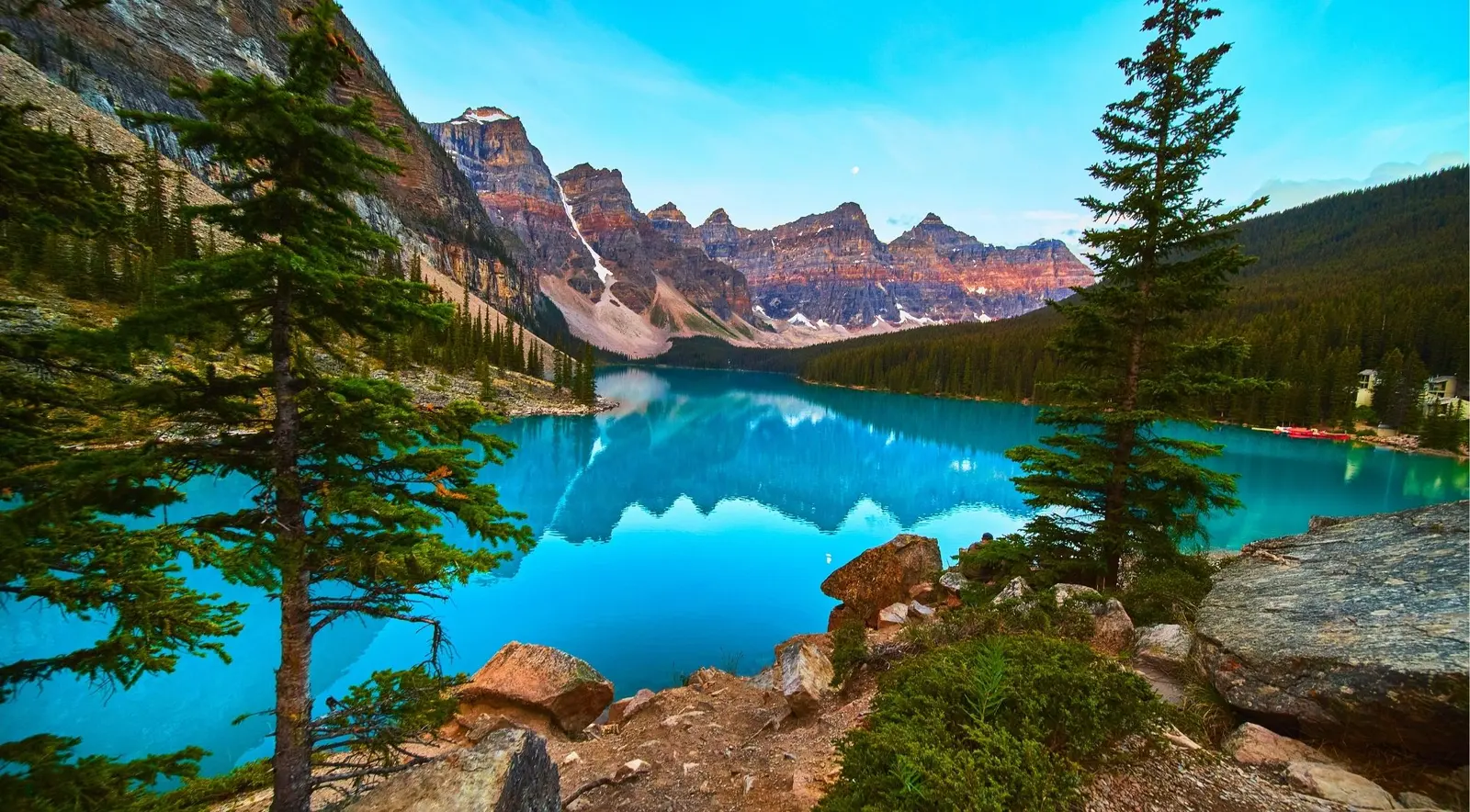
A turquoise glacial lake below forested peaks in the Canadian Rockies, the kind of lake that lines the Icefields Parkway
Banff to Jasper · Icefields Parkway · 2026

Banff to Jasper: The Icefields Parkway Wildlife Guide

The Icefields Parkway runs 232 kilometres from Lake Louise to Jasper past glaciers, turquoise lakes and hanging valleys. It is also one of the best wildlife roads in North America: unfenced, with bighorn sheep standing on the road, goats coming down to lick minerals and bears feeding on the spring green-up.

Every major stop, south to northWhere and when to look for wildlife
  • 232 kmLake Louise to Jasper
  • ~290 kmFrom Banff town
  • 3–3.5 hrsParkway without stops
  • 1Fuel stop, closed in winter
  • ~2,088 mBow Summit, the high point
The short answer

Fill Up First, and Give It a Full Day

The road is open all year, but winter driving here is serious, and there is only one fuel stop between Lake Louise and Jasper. Fill the tank before you leave, and give yourself far more time than the three-hour driving time suggests: with stops at the lakes, glaciers and viewpoints, the Parkway is a full day, and better still spread over two. Drive it at dawn or late afternoon for the best chance of sheep, goats, elk and bears.

Check live availability and prices on GetYourGuide. Pоwered by GetYourGuide.

If you would rather not drive, the calendar above books the Columbia Icefield, Skywalk, Crowfoot Glacier and Lakes Tour (from $77, ★ 4.7 from 983 reviews on GetYourGuide). It is a full guided day from Calgary, Canmore or Banff to Crowfoot Glacier, Bow Lake, Peyto Lake and the Columbia Icefield, with the park pass included. The Ice Explorer and Skywalk tickets are extra; more on that below.

Highway 93 North

The Basics

Highway 93 North runs 232 km from Lake Louise to Jasper, through Banff and Jasper National Parks and roughly parallel to the Continental Divide. From the town of Banff, add about 60 km, for around 290 km in all. Without stops it is a 3-to-3.5-hour drive on the Parkway itself; done properly, stopping at the lakes, glaciers and viewpoints, it is a full day, and better still spread across two.

The high point is Bow Summit, at about 2,088 m. You need a Parks Canada pass for the whole drive, because it runs through two national parks; our Banff National Park pass guide explains the options.

Before you set out

Plan for These Three Things

  • Fuel. This is the most important piece of planning. The only gas between Lake Louise and Jasper is at Saskatchewan River Crossing, about 80 km north of Lake Louise; it costs more there, and the station closes in winter. Fill up in Lake Louise or Jasper before you set out.
  • Cell service. There is effectively none along the Parkway. Download maps and any audio guide before you go, and don't rely on your phone for navigation or emergencies.
  • Weather. Snow can fall in any month, including midsummer. The road is open year-round, but driving it in winter is a serious undertaking (see Seasonal notes).
Along the way

Other Experiences You Might Enjoy

Tours on and around the Icefields Parkway.

Most guided days on this road combine Bow Lake, Peyto Lake and the Crowfoot Glacier with the Columbia Icefield and the Athabasca Glacier; some carry on to Athabasca Falls and Jasper, and in winter to the frozen bubbles of Abraham Lake. Back in Banff and Lake Louise, dawn and dusk wildlife safaris fill the days either side. The live options below update automatically for experiences in and around Banff National Park.

Lake Louise to Jasper

The Major Stops, South to North

  • Herbert Lake (about 7 km from Lake Louise): a small lake right beside the road, known for mirror reflections at sunrise. A quick first stop.
  • Crowfoot Glacier viewpoint: a glacier clinging to Crowfoot Mountain, named for its bird-foot "toes". One toe has since melted away, a marker of retreat in itself.
  • Bow Lake and Bow Glacier: one of the largest lakes in Banff, a brilliant aquamarine fed by the Wapta Icefield. The historic red-roofed lodge on its shore, formerly Num-Ti-Jah, has reopened as The Lodge at Bow Lake, and the Bow Glacier Falls trail starts here. Our best photography spots guide covers shooting Bow Lake at dawn.
  • Bow Summit and Peyto Lake: the highest point on the drive and one of the most photographed lakes in the Rockies. A paved 10-minute walk reaches the platform above Peyto's wolf-head shape and its startling turquoise. Arrive early, because the car park fills by mid-morning.
  • Mistaya Canyon: a short, steep walk down to a footbridge over a narrow limestone slot where the river churns. One of the most rewarding quick stops.
  • Saskatchewan River Crossing: the only services on the entire Parkway, with gas, food, washrooms and lodging.
  • The Big Bend and the Weeping Wall: the Weeping Wall is a cliff where waterfalls drop over 100 m, and an ice-climbing venue in winter. The road then climbs through a dramatic hairpin with sweeping valley views.
  • Parker Ridge: a climb of about 2 hours to a superb view of the Saskatchewan Glacier. It is often closed from late spring into early summer to protect the fragile landscape.
  • Wilcox Pass: the best wildlife-and-views hike on the Parkway (see The hikes).
  • Columbia Icefield and Athabasca Glacier: the centrepiece (see below).
  • Tangle Falls: a pretty, tiered roadside waterfall where bighorn sheep are often seen right by the road.
  • Sunwapta Falls: glacier-fed falls dropping through a narrow gorge, a short walk from the car park.
  • Athabasca Falls (about 30 km south of Jasper): not tall, but immense in volume and force, among the most powerful falls in the Rockies.
  • Goats and Glaciers viewpoint: about 37 km south of Jasper, above the Athabasca River, where mountain goats come to lick minerals from the bank. It is one of the most reliable roadside goat spots in the Rockies; watch for the goat-warning sign.
  • Valley of the Five Lakes (about 9 km south of Jasper): an easy, popular loop past five vividly coloured lakes. It is prime bear habitat in berry season, so carry bear spray.
The centrepiece

The Columbia Icefield and Athabasca Glacier

The Columbia Icefield is the largest in the Canadian Rockies, covering more than 200 km² of high plateau. It sits at the "hydrographic apex of North America": its meltwater drains to three oceans.

The Athabasca Glacier flows down toward the Parkway opposite the Icefield Centre and is the classic climate-change teaching example. It has retreated more than 1.5 km and lost over half its volume in about 125 years, and the ice is still thinning fast.

You can see it in several ways:

  • The Columbia Icefield Adventure (Ice Explorer): huge snowcoaches carry you onto the glacier, where you step out onto the ice with guides. It is sold together with the Skywalk as the Columbia Icefield Tour with Glacier Skywalk (about 3 hours, from about $75, ★ 4.7 from 2,167 reviews on Viator).
  • The Columbia Icefield Skywalk: a glass-floored platform 280 m above the Sunwapta Valley.
  • The Glacier Discovery Centre: the hub for the tours, with exhibits and dining, plus the Glacier View Lodge for overnight stays.
  • Free options: short trails reach the glacier's toe. Do not walk onto the ice without a guide: hidden crevasses have proven fatal. Wilcox Pass and Parker Ridge give balcony views for nothing.

Pursuit, part of the Banff Jasper Collection, runs the Ice Explorer and Skywalk. They are closed for the rest of 2026, and the published dates for 2027 are May 1 to October 11, weather dependent. Book ahead for July and August, when tours sell out. Dress in layers with grippy, closed-toe shoes: it can feel like winter on the ice even in July.

Most guided Parkway day tours sell the drive only. On the Columbia Icefield, Skywalk, Crowfoot Glacier and Lakes Tour, for example, the Ice Explorer and Skywalk tickets are not included, and the operator asks you to buy them from Pursuit in advance for an early-afternoon slot.
The main event

Wildlife on the Parkway

The Parkway has been called Canada's answer to an African safari drive. What to look for, and where.

  • Bighorn sheep: common and often at road level, especially around the Big Bend, Wilcox Creek, the Columbia Icefield and Tangle Falls. Rams are reliably seen on the Wilcox Pass trail. See our bighorn sheep guide.
  • Mountain goats: your best chance is the Goats and Glaciers viewpoint, where they come down to lick minerals; otherwise they stay high on the cliffs.
  • Black and grizzly bears: both feed on roadside vegetation, especially in spring and early summer. Seeing one is a matter of luck and timing. See our bear watching guide.
  • Elk, deer and moose: elk are the most common large mammal. Moose favour the wetlands around Waterfowl Lakes and north of Saskatchewan Crossing.
  • Wolves and coyotes: present but elusive; wolves occasionally show on the northern stretch early or late in the day.
  • Pikas and marmots: reliable at the higher stops and on the hikes: Parker Ridge, Wilcox Pass, Helen Lake and Bow Summit.
  • Birds: Waterfowl Lakes has ducks, ospreys and eagles, and ptarmigan live in the alpine.

Best times and etiquette. Dawn to mid-morning is the most productive time, and late afternoon to dusk the next best. The northern half, toward Jasper, is generally better for wildlife, especially in late summer. Drive slowly, watch for the reduced-speed wildlife zones, and keep the legal distances: 100 m from bears, wolves and coyotes; 30 m from elk, sheep, goats and moose. In a bear jam, stay in your vehicle, pull fully off the road, use your hazard lights and don't block the animal's route. Never feed wildlife; fines reach $25,000.

Slow down for another reason too. Unlike the fenced Trans-Canada with its wildlife crossings, the Parkway is unfenced, and vehicle collisions are the leading cause of premature death for its large mammals. For the self-drive roads around Banff itself, see our best places to see wildlife guide.

Out of the car

The Hikes

  • Wilcox Pass: the standout. About 8 km return, or 2.4 km to the first viewpoint, starting near Wilcox Creek Campground. Expect bighorn sheep, often goats, marmots and pikas, and a superb view of the Athabasca Glacier without paying for the commercial tour.
  • Parker Ridge: about 5 km return to a view of the Saskatchewan Glacier; often closed in late spring and early summer.
  • Helen Lake: about 12 km return, one of the finest moderate hikes on the Parkway, through alpine meadows full of marmots and pikas.
  • Bow Glacier Falls: from Bow Lake, about 9 km return to the source of the Bow River.
  • Shorter walks: Mistaya Canyon, Sunwapta Falls, Horseshoe Lake and the Valley of the Five Lakes near Jasper are easy family options.

Carry bear spray on every hike, and check Parks Canada's trail bulletins for closures.

The northern end

Arriving in Jasper

Jasper National Park is the largest in the Canadian Rockies: bigger, wilder and less crowded than Banff, with some of the darkest night skies on the continent. Fewer visitors often means more reliable sightings than on Banff's busier corridors; our Banff vs Jasper wildlife comparison sets the two side by side. For guided days at the northern end, browse tours from Jasper on GetYourGuide.

The July 2024 wildfire and where things stand in 2026. In late July 2024 the largest wildfire in Jasper's recorded history swept into the townsite, burning roughly 32,700 hectares and destroying about a third of the town's structures. Jasper reopened to visitors in September 2024, and by 2026 recovery is well under way. Federal commitments to response and recovery now total more than $900 million, including $520 million announced in June 2026. More than 25 hotels and over 70 restaurants are operating, and major attractions including the Columbia Icefield, Maligne Lake and Miette Hot Springs have reopened. Some areas remain closed for restoration, Maligne Canyon and Cavell Road among them, along with several campgrounds. The situation keeps changing, so check the Parks Canada interactive closure map before you travel. Visitors are genuinely welcome: tourism is an important part of the town's recovery.

How to fit it in

Day Trip or Overnight?

Ratings and review counts are GetYourGuide's, checked October 2026.

Driving one way from Lake Louise to Jasper with a night in Jasper is the best way to do the Parkway justice. A same-day round trip from Banff is punishing, with over six hours of driving before any stops, so if you have to come back the same day, make the Columbia Icefield your turnaround and leave Jasper for another trip.

Guided or self-drive? Driving yourself gives you total freedom and the best chance of pulling over for wildlife. Guided day tours from Banff or Lake Louise do the driving and add commentary, but they run to a fixed schedule, and many don't include the Ice Explorer or Skywalk. Pursuit (the Banff Jasper Collection) runs the Icefield attractions and its own combination tours. Our Banff tours guide compares the main day trips, and these two cover the Parkway:

Columbia Icefield, Skywalk, Crowfoot Glacier and Lakes Tour

From $77 · ★ 4.7 (983 reviews) · full day

The more-reviewed of these two, with pickup in Calgary, Canmore or Banff, the park pass, a local guide and snacks included. The Ice Explorer and Skywalk tickets are extra, and from mid-October to the end of April, when the Icefield attractions are closed, the day visits Marble or Johnston Canyon instead.

Check availability & prices

Abraham Lake ice bubbles and Icefields Parkway day tour

★ 4.9 (326 reviews) · about 10.5 hours · small group

The higher-rated choice, and the one for a winter trip: from December to the end of March it visits the frozen bubbles of Abraham Lake, and in summer it goes on to Athabasca Falls, Sunwapta Falls and the Athabasca Glacier. Bow and Peyto lakes are on the route in both seasons.

Check availability & prices

Places to stay along the road are few, so book well ahead. The options include The Lodge at Bow Lake, Saskatchewan River Crossing, the Glacier View Lodge at the Icefield and Sunwapta Falls Lodge, plus Parks Canada campgrounds.

Summer, shoulder and winter

Seasonal Notes

  • Summer (late June to September): full access, every service open and the best weather, which also makes it the busiest time. Snow can still fall.
  • Shoulder season (May to early June, late September to October): fewer crowds. The Icefield tours run within their May 1 to October 11 window in 2027, but lakes may still be part-frozen early in the season and higher trails snowbound. Autumn brings the elk rut and good wildlife activity.
  • Winter (November to April): the road stays open but becomes a serious mountain drive. Winter tires or chains are required by law from November 1 to March 31; services close; there is no cell coverage; and avalanches and weather close the road at times. Carry a full emergency kit, check 511 Alberta, and don't attempt it without winter-driving experience. If the Parkway closes, the detour turns a 3-hour trip into 7 to 8 hours.

For the month-by-month picture around Banff, see our best time to visit Banff for wildlife guide.

Ice in retreat

The Glaciers Are a Climate Story

The Athabasca Glacier tells one of the most visible climate stories on Earth. Markers along its forefield show where the ice stood in past decades, and you can see the retreat with your own eyes. Parks Canada says the glacier lost more ice in 2023 than in any of the previous ten years, and a University of Saskatchewan hydrologist measured nearly 9 metres of thinning in the year to September 2023, far beyond the old record. The 2024 Jasper wildfire made it worse, leaving soot that darkens the ice and speeds the melt. Park managers have warned that the glacier could largely disappear within a generation. For visitors the message is simple: this landscape is changing in real time, and the chance to see it as it is today is narrowing.

Common questions

Icefields Parkway: FAQs

What drivers ask most about the road from Banff to Jasper.

How long is the drive from Banff to Jasper?

The Icefields Parkway is 232 km from Lake Louise to Jasper, and the whole trip from the town of Banff is about 290 km. That is roughly 3 to 3.5 hours on the Parkway without stops, but plan on a full day once you stop.

Is the Icefields Parkway worth it?

Yes. It is one of the most scenic drives in the world and one of the best wildlife roads in the Rockies, with glaciers, turquoise lakes and frequent sightings of bighorn sheep, plus mountain goats and bears if your timing is good.

What are the best stops on the Icefields Parkway?

Peyto Lake, Bow Lake, Mistaya Canyon, the Columbia Icefield and Athabasca Glacier, Athabasca Falls and the Goats and Glaciers viewpoint. Wilcox Pass is the best short hike.

Where do you see wildlife on the Icefields Parkway?

Bighorn sheep around the Big Bend, Wilcox Creek and the Icefield; mountain goats at the Goats and Glaciers viewpoint; moose around Waterfowl Lakes; and bears along the roadside in spring. Drive at dawn or dusk and go slowly.

Is there gas on the Icefields Parkway?

Only at Saskatchewan River Crossing, about 80 km north of Lake Louise, and it closes in winter. Fill up in Lake Louise or Jasper before you set out, because there is no other fuel for over 200 km.

Can I do the Icefields Parkway as a day trip from Banff?

You can, but it is long: over six hours of driving for the round trip before any stops. It is better to drive one way with a night in Jasper, or to make the Columbia Icefield your turnaround.

Is Jasper open after the 2024 wildfire?

Yes. Jasper reopened to visitors in September 2024 and welcomes visitors in 2026, with hotels, restaurants and major attractions operating. Some areas, including Maligne Canyon and Cavell Road, remain closed for restoration, so check the Parks Canada closure map before you travel.

When is the Columbia Icefield open?

The Ice Explorer and Skywalk are closed for the rest of 2026. Pursuit's published dates for 2027 are May 1 to October 11, weather dependent. Book ahead for July and August. Outside that window, see the glacier from the toe trail or Wilcox Pass.

Start at dawn

Drive It for the Wildlife

Fill up, start at dawn and drive slowly with binoculars handy. Patience on the Parkway usually brings sheep and often goats, and with luck a bear. If you'd rather not drive it yourself, a guided tour handles the logistics and adds the context.

  • Pickup in Calgary, Canmore or Banff on the main Icefield day tour
  • Park pass included, so there is one less thing to buy
  • Free cancellation on most tours — book with confidence
Check Icefields Tour Availability

We may earn a commission from bookings made through our links, at no extra cost to you. See our affiliate disclosure.