Horns, not antlers
Deer, elk and moose grow and shed solid-bone antlers every single year. Sheep horns are permanent — a bony core sheathed in keratin (the protein in hair and fingernails), grown continuously through life and never shed.
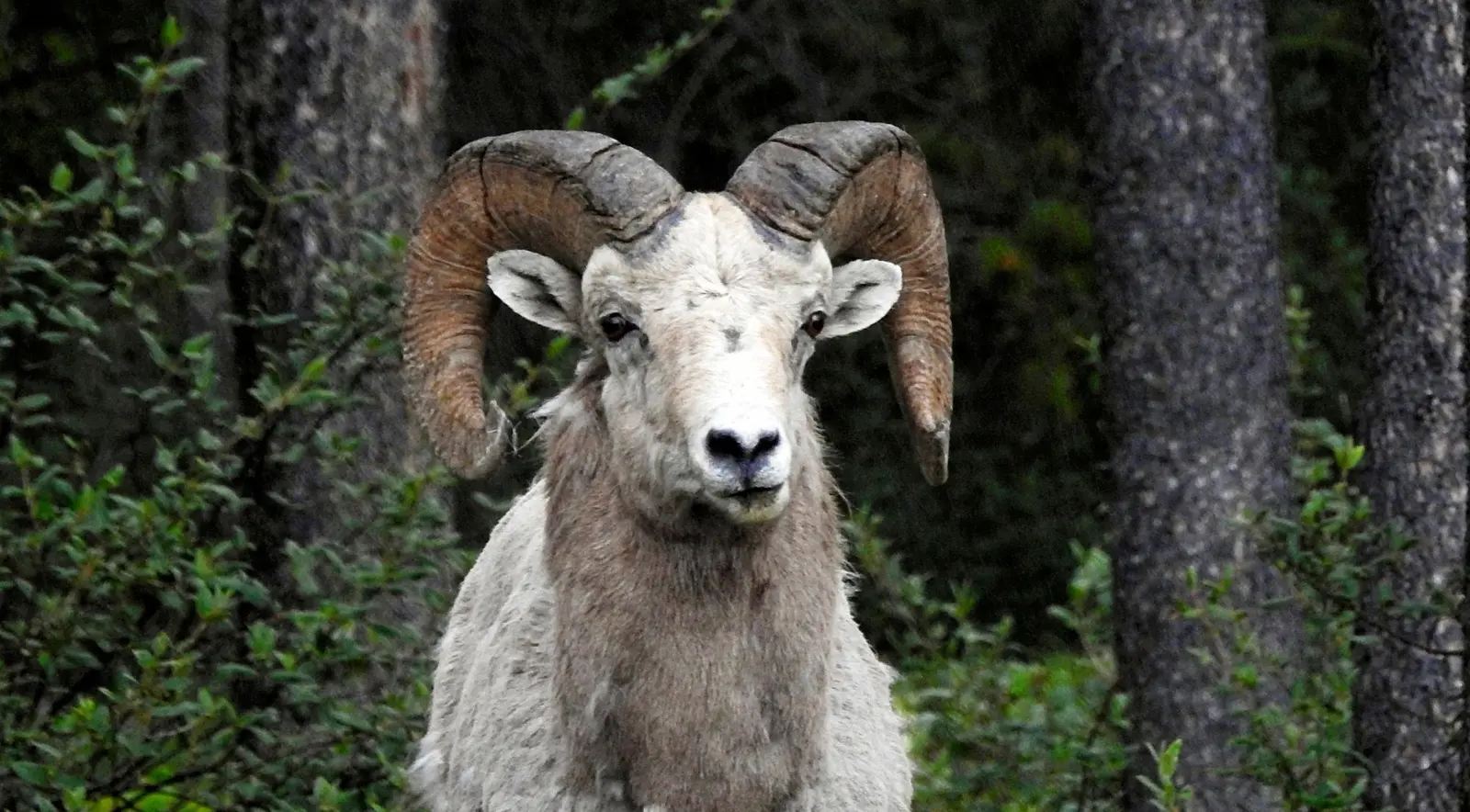
Bighorn sheep are among the most spectacular animals anywhere. They're Alberta's provincial mammal, they've shared these slopes with people for 13,000 years, and you can see one from a paved pull-off on the Lake Minnewanka road most days of the year. This is the complete guide to the animal — the biology, the horns, the rut — and exactly where and when to find them.
A stocky, cliff-climbing wild sheep, named by the naturalist George Shaw in 1804 — Ovis is Latin for "sheep," canadensis means "of Canada."
The Rocky Mountain bighorn (the largest, and the one you'll see in Banff), the desert bighorn of the Southwest, and the endangered Sierra Nevada bighorn. Every sheep in Banff, Jasper, Kootenay and Kananaskis is a Rocky Mountain bighorn.
Ovis dalli — the white Dall's and grey Stone's sheep — live in the Yukon and northern BC, with slender amber horns. You won't see them in Banff.
The distinction is simple once you know it — and it settles almost every roadside argument in the park.
Bighorns are brown, with a white rump and brown curling horns. Mountain goats are shaggy white, with beards and short black dagger-horns on both sexes. Goats live high on cliffs and are rarely seen from the road; bighorns graze at roadside. If it's a brown, sheep-shaped animal with curling horns near a Banff road, it's a bighorn.
One counterintuitive footnote: where the two compete at high mineral licks, the smaller goats actually dominate and displace the sheep most of the time.
Sheep-watching pairs naturally with the rest of a Rockies trip — most of it within an hour of the same pull-offs.
The best sheep roads run through the middle of everything else worth doing: the Lake Minnewanka Loop and Two Jack Lake, the Bow Valley Parkway, the Icefields Parkway north to the Columbia Icefield, the Sulphur Mountain summit above Banff, and Highway 40 through Kananaskis. Add a sunrise run to Moraine Lake or Lake Louise, a walk through Johnston Canyon, or a guided wildlife safari out of Banff or Canmore. The live options below update automatically for available experiences in and around Banff National Park and the Bow Valley.
Rams typically weigh 58–143kg (exceptional ones top 230kg), standing 90–105cm at the shoulder. Ewes are much smaller, 34–91kg. That pronounced size gap — big heavy-horned males, slender-horned females — is a defining trait.
The coat runs light brown to dark chocolate, with a distinctive white rump patch, muzzle and belly. It's seasonal — the thick winter coat sheds in summer, so sheep look paler in spring. Their split hooves have a hard rim around a soft, high-friction pad that grips rock like climbing shoes, and their eyesight is famously sharp, spotting predators at long range.
They live roughly 10–12 years typically, with survivors reaching 15–17; ewes generally outlive rams. Treat weights, horn dimensions, lifespans and rut dates as typical rather than absolute — they vary by source and by population.
They work nothing like antlers — and that difference explains almost everything about how a ram lives.
Deer, elk and moose grow and shed solid-bone antlers every single year. Sheep horns are permanent — a bony core sheathed in keratin (the protein in hair and fingernails), grown continuously through life and never shed.
A mature ram's horns curl in a massive spiral back over the ears and down past the cheeks. They can exceed a metre along the outer curve and weigh up to 14kg — as much as all his other bones combined. A full curl typically isn't reached until the ram is seven or eight.
Because horn growth slows in winter and speeds up in the growing season, the horn records annual growth rings, called annuli — you can age a ram by counting them, like tree rings. The prominent dark "four-year ring" marks the onset of rutting stress and is the reference point biologists use.
Old rams often "broom" their horns — wearing, breaking or knocking off the tips through fighting and feeding, sometimes to clear their field of vision once the curl comes round toward the eyes. Ewe horns, by contrast, are short, thin and only slightly curved, never more than a half-curl. Horn size is a direct signal of a ram's age, dominance and mating rights.
The autumn rut produces the combat the species is famous for.
Rams don't hold territories. They compete directly for ewes, and the contest is the head-on charge: two rams rear up, drop to all fours, and slam together horn-first at up to 30km/h, with a crack audible up to a mile away. Contests establish dominance and can go on for hours.
The biomechanics are extraordinary. Rams have evolved a double-layered skull — enlarged sinuses, internal bony struts, large horn cores — plus massive neck muscle, all of which absorb and distribute the impact and protect the brain. The horns dissipate energy by flexing rather than breaking. It's why bighorn skulls have inspired helmet research.
The protection is real but not perfect: a 2022 study led by Dr Nicole Ackermans at Mount Sinai found some tau-protein markers of brain trauma in bighorns and muskox — though such lesions were rare in the sheep. Worth respecting rather than overstating.
After the rut, ewes carry their young about six months. Lambing peaks in late May and June. Just before giving birth, a ewe isolates herself on a steep cliff ledge where predators can't follow — traditional lambing grounds used year after year. She almost always bears a single lamb; twins are rare.
Lambs are remarkably capable. They can walk within hours and follow their mother across rock within a week. Ewes and lambs gather into nursery groups, and lambs are weaned by four to six months.
Ewes mature around 2.5 years. Rams are physically capable at a similar age but, because of the dominance hierarchy, rarely breed until seven or older, once they've grown the horn mass to compete. Lamb mortality is high — roughly a third don't survive their first summer.
For most of the year, bighorns live in sexually segregated groups. Adult rams form bachelor bands; ewes, lambs and yearlings live in matriarchal nursery groups led by older ewes. Young females stay with their mother's group for life; young rams leave at two to four years to join the bachelors. The sexes come together only for the rut.
They're seasonal migrants, climbing to high alpine meadows in summer and descending to lower, wind-swept, south-facing slopes in winter where snow is shallow enough to feed. This is why the big rams are easiest to see at road level in winter and early spring, and why many vanish to the high country in midsummer.
Bighorns are grazers — grasses, sedges, forbs — digesting tough mountain vegetation through a ruminant's multi-chambered stomach.
But they crave minerals and salt. They seek out natural mineral licks, and they're powerfully drawn to the road salt and grit applied to highways in winter, licking it straight off the pavement and out of cracks in the asphalt. They'll even lick it off parked cars.
That's exactly why sheep congregate along the Lake Minnewanka Loop, Mount Norquay Road, and the highways around Radium. It makes for wonderful viewing — and real danger: sheep on roads get struck by vehicles and ingest oil, brake fluid and tyre residue along with the salt. On Highway 93 south of Radium, Parks Canada research documented sheep both crossing the road and spending substantial time licking road salt in winter, on a stretch highly prone to collisions.
The defining bighorn habitat pairs open grassy slopes to feed on and adjacent steep, broken "escape terrain" — cliffs they flee to when threatened. They rely on climbing ability and eyesight rather than speed: spot the danger early, then bound onto near-vertical rock where cougars and wolves can't follow. They avoid deep snow, which is why they move to wind-cleared winter ranges.
Predation shapes bighorn behaviour. Disease is what actually collapses herds.
The cougar is the primary predator of adult bighorns in the Canadian Rockies. A long-term Alberta study in the Sheep River area found cougars accounted for as much as 57% of over-winter sheep mortality in some years. Wolves and coyotes take sheep too; lambs are additionally vulnerable to golden eagles, coyotes, bobcats and lynx.
The biggest threat isn't a predator — it's disease. Bighorns are devastatingly susceptible to respiratory pneumonia, and the main agent is Mycoplasma ovipneumoniae, carried harmlessly by domestic sheep and goats but lethal to wild bighorns with no immunity. When it hits a naïve herd, an all-age die-off can be catastrophic — a median of around 48% mortality, and experimental contact with domestic sheep kills over 95% of exposed bighorns. Worse, survivors become chronic carriers, infecting each year's lambs and suppressing recovery for years.
Keeping wild bighorns separate from domestic sheep and goats is the central management priority for the species. A die-off in the early 1980s killed about three-quarters of one southern Alberta herd.
Parks Canada flagged concerns in 2015 after a sick ewe near Sunshine led to the discovery of a herpes-type virus in park sheep — malignant catarrhal fever, distinct from the pneumonia agent. That prompted a study in which ecologist Jesse Whittington fitted 17 bighorns with GPS collars, noting little research had been done on Banff's sheep in three decades. For more on how disease and predation shape the park's wildlife, see our wildlife tours overview.
Before European settlement, North America may have held 1.5 to 2 million bighorns. Through the late 1800s and early 1900s the population crashed — market hunting, competition with livestock, and above all diseases from domestic sheep drove many herds below 10% of their historic numbers, and some subspecies extinct.
Today, thanks to regulated hunting, habitat protection, translocations and national parks, Rocky Mountain bighorns are relatively stable and considered secure — far better off than the endangered Sierra Nevada and Peninsular populations. Estimates vary: Alberta holds roughly 9,000 sheep, and North American totals range from about 40,000 to 65,000 depending on the source. There is no reliable published figure for Banff specifically — Parks Canada has said it knows relatively little, which is what the collaring study was for. Treat all of these numbers as approximate.
The bighorn is Alberta's official provincial mammal, designated in 1989. Within Banff, Jasper, Kootenay and Waterton the sheep are fully protected — which is why mature full-curl rams, rare outside protected land because of hunting pressure, are such a special sight here.
The best spots, in order.
The top spot. The cliffs on the stretch between Two Jack Lake and the Minnewanka dam are reliable, and sheep frequently stand on or cross the road. See our Lake Minnewanka guide.
The switchbacks up to the ski area and lookout; a herd often grazes in the meadow near the top.
Take the gondola or hike up, and sheep are commonly seen right beside the summit boardwalk in the warmer months.
Especially around Backswamp.
The northern reaches near the Big Bend, Saskatchewan Crossing and Wilcox Pass, where sheep come to the road, especially in winter.
Every road above, with parking, timing and seasonal closures, is covered in Best Places to See Wildlife in Banff. For the wider trip, see things to do in Banff National Park.
Highway 40 through the valley is nicknamed the "Bighorn Highway" and carries a sheep on its road signs. Sheep River Provincial Park protects the winter range of around 200 sheep, and Kananaskis holds an estimated 2,000.
Disaster Point, a mineral lick on Highway 16 east of Jasper, is a near-guaranteed spot where a dozen or more gather. (The nearby "Goat Lick" viewpoints are for mountain goats, not sheep.) For the wider comparison, see Banff vs Jasper for wildlife.
The village is genuinely famous for bighorns wandering the streets, seen around town almost daily. A herd of about 160 gathers here, and the town even holds an autumn "Headbanger Festival" celebrating the rut — check current dates before planning a trip around it.
Sheep are regularly seen around the townsite.
Dawn and dusk for activity; winter and early spring for the big rams at road level; November–December for the rut and possible head-butting; late May–June for lambs.
The Minnewanka Loop at dawn works fine on your own. A guide adds the corridors that don't appear on a tourist map, plus a spotting scope.
The itinerary runs through the wildlife corridors this guide keeps naming — Lake Minnewanka and Two Jack Lake, where Banff's resident sheep congregate on the shoulders and cliffs — with a maximum of 12 guests and a panoramic-window vehicle you can shoot through. The operator's own highlight is "travel through wildlife corridors to likely see bears, elk, and bighorn sheep." Rating and review count shown as published by GetYourGuide.
Free cancellation. Small group, 95% sightings. Secure booking via GetYourGuide.
Habituation to people and to road salt is what kills bighorns near Banff. These five rules are the whole of it.
About three bus lengths — from sheep and other ungulates, including from your car. It's the legal minimum.
Feeding and road-salt habituation lead directly to collisions, aggression and disease spread. Feeding wildlife is illegal, with fines up to $25,000.
Sheep on roads are a real collision hazard. Slow down, don't stop on blind corners, don't block traffic, and view from a proper pullout.
Give rutting rams and lambing ewes extra space. Their horns and hooves are dangerous.
If the animal reacts to you, you're too close. Our photography guide covers lenses and angles in more detail.
Bighorns have been part of human life in these mountains for millennia. At Lake Minnewanka — Minn-waki to the Stoney Nakoda, "Lake of the Spirits" — archaeological sites document human presence back roughly 13,000 years, including a Clovis point that is the oldest archaeological find in Banff. For these First Nations the mountains were sacred, and bighorn sheep were an important resource, hunted along the same slopes where visitors watch them today. Bighorn petroglyphs are among the most common Indigenous rock-art images across western North America.
Today that cultural weight is formalised: the bighorn sheep is Alberta's provincial mammal, an emblem of the mountains it calls home.
The questions visitors ask most before and after their first roadside sighting.
The Lake Minnewanka Loop (between Two Jack Lake and the dam) is the most reliable spot, followed by Mount Norquay Road and the Sulphur Mountain summit. Drive slowly — they stand in the road licking grit.
Bighorns are brown with a white rump and brown curling horns. Mountain goats are shaggy white with beards and short black dagger-horns. If it's near a road and brown, it's a sheep.
A mature ram's horns can weigh up to 14kg — as much as all the other bones in his body combined. They're permanent and grow throughout life, unlike deer antlers, which are shed yearly.
November and December. That's when you might witness rams charging and clashing horns, though it's never guaranteed.
They're drawn to road salt and grit, which they lick off the pavement. This makes them easy to see but also causes vehicle collisions — so drive slowly in sheep areas.
Generally not if you keep your distance, but rutting rams and lambing ewes can be provoked, and their horns and hooves are dangerous. Stay 30 metres back and never feed them.
By counting the growth rings (annuli) on its horns, like tree rings. The prominent dark "four-year ring" is the reference point biologists use.
Rocky Mountain bighorns are relatively stable and considered secure, though the species crashed historically and some other subspecies remain endangered. Disease from domestic sheep is the biggest ongoing threat.