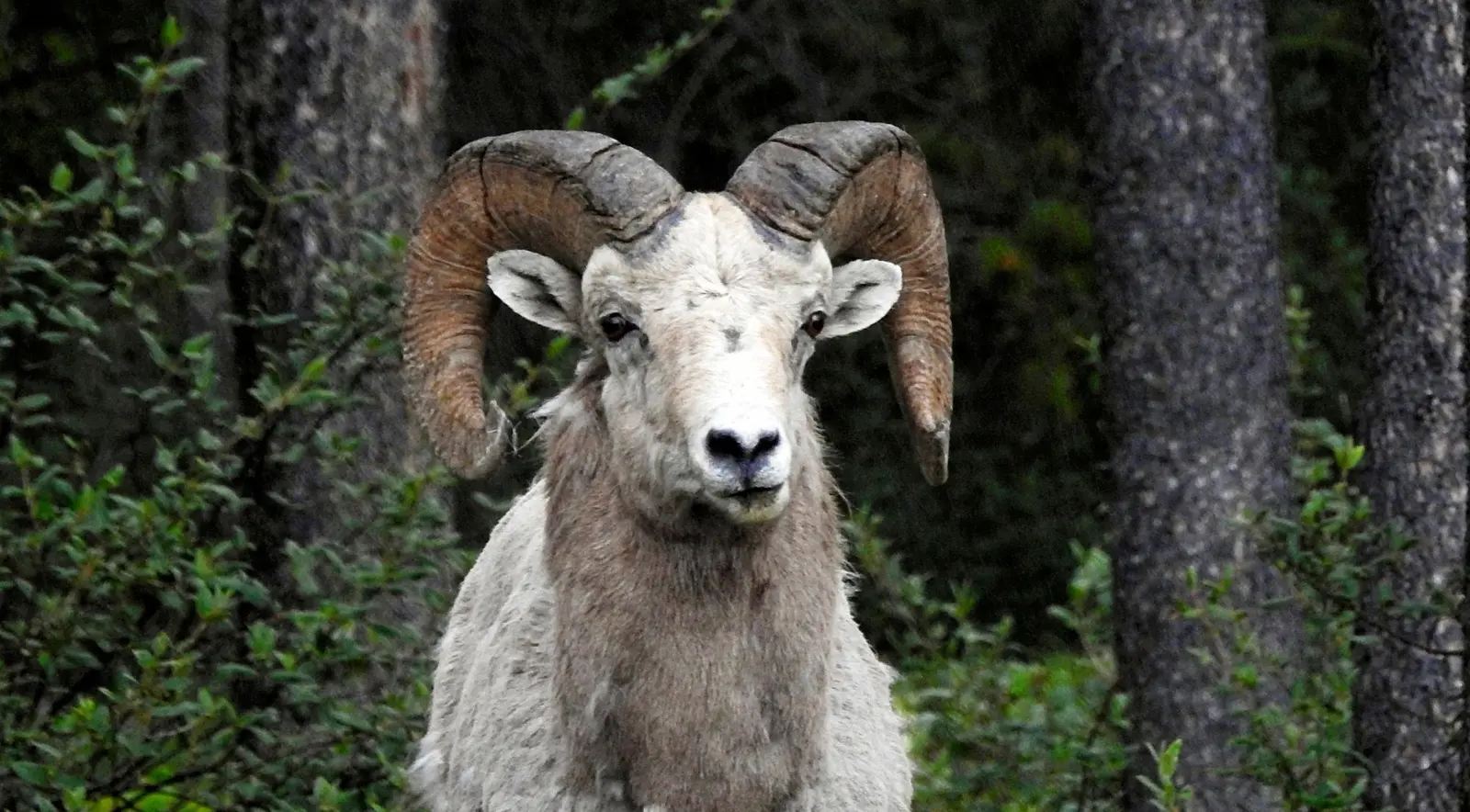
A bighorn sheep ram on the Lake Minnewanka Loop near Two Jack Lake in Banff National Park
Lake Minnewanka & Two Jack Lake · Banff's wildlife corner · 2026

Lake Minnewanka & Two Jack Lake: Banff's Wildlife Corner

If you want to see bighorn sheep in Banff, this is where you go — not the gondola, not a tour brochure, but the stretch of road between Two Jack Lake and the Minnewanka dam, where resident herds stand in the road licking grit off the pavement, minutes from the townsite. It's also a full day out on its own: a narrated boat cruise over a submerged ghost town, warm-water swimming, the most photographed lake reflection in Banff, and 13,000 years of human history.

Most reliable bighorn sheep spot24km loop, 5 minutes from town
  • 18 kmLake length (Parks Canada)
  • 24 kmMinnewanka Loop drive
  • Nov–MayWestern loop closure
  • 10 Jul–15 SepBear group-of-4 hiking window
  • ~13,000 yrsDocumented human history
Why this corner of Banff is different

Banff's Wildlife Corner Isn't an Accident of Geography

The Lake Minnewanka Loop sits on part of the park's rare montane valley bottom, threaded by wildlife corridors and sitting on the edge of grizzly country. It's why the sheep are here, why the elk graze the Cascade meadows, and why Parks Canada closes half the road every winter and restricts the trails in berry season.

Check live availability and prices on GetYourGuide. Pоwered by GetYourGuide.
Size, name, and a submerged town

Lake Minnewanka Itself

Lake Minnewanka is the largest lake in Banff National Park. On its exact size, sources genuinely disagree: most travel media cite about 21km long and up to 142m deep, but Parks Canada's own scuba page gives 18km long and 100m maximum depth — for anything you rely on, take the Parks Canada figure. Either way, it's big, fed by the Cascade River and around fifty natural springs, and ringed by Mount Inglismaldie, Mount Aylmer and Cascade Mountain.

The name is Stoney Nakoda, usually rendered "Minn-waki" and translated as "Lake of the Spirits" or "Water of the Spirits" — a more precise form is "mînî wakâ," "sacred water." The Stoney Nakoda both respected and feared it; European settlers called it Devil's Lake, a name that survives in nearby Devil's Gap. Legends tell of a water spirit and a serpent as long as the lake itself.

The lake is largely man-made. A first dam went up in 1912. Then, during the Second World War, Calgary Power built a much larger dam in 1941 that raised the water level 30 metres — flooding the townsite, the old dam, and the bridge at Devil's Creek, and diverting most of the Cascade River into Two Jack Lake through a canal. Which created a ghost town underwater. Minnewanka Landing was a summer resort village from 1888 — hotels, restaurants, wharves, avenues, cottage lots — all submerged by the 1941 flood. Today it's one of the most intact underwater villages in Canada and Banff's premier scuba site: Parks Canada documents 16 features across three diving areas, where divers see building foundations, wharves, pilings and the old dam at depths of roughly 15–26 metres. Around 8,000 divers a year come to see it. The lake still surprises: in May 2025 a dive team surfaced with photo evidence of a car on the bottom, believed to be a 1928 Hudson Essex. Nothing may be added or removed.
The area's flagship paid experience

The Lake Minnewanka Cruise

The narrated cruise, run by Pursuit's Banff Jasper Collection, is the area's flagship paid experience. The classic trip runs about 60 minutes (premium options up to 90), departing from the dock roughly a 10-minute drive from Banff. An interpretive guide narrates the water-spirits legend, the submerged town, and the region's Indigenous history while you scan for bald eagles, bighorn sheep and the occasional bear. The boat cruises to Devil's Gap at the lake's eastern end, where the mountains part to frame the prairies beyond, before turning back. Boats are glass-enclosed. The season runs roughly mid-May to mid-October, with departures as often as every 30 minutes in peak summer. Most boats are wheelchair accessible on the back deck only — the interior isn't, so contact the boathouse ahead if that matters. Bear spray isn't permitted onboard. (Check current prices directly.)

Other boating. Lake Minnewanka is the only lake in Banff open to private motorized boats — but every motorized craft must pass a Parks Canada inspection at the station about 6km along the Loop before launching, and provincial inspections aren't accepted. Kayaks, canoes and paddleboards need a Clean, Drain, Dry self-certification; jet skis are banned. Rentals are available at the boathouse in season. Fishing: the lake is a renowned lake trout fishery, and guided charters run from the dock roughly mid-May through early September. A national park fishing permit is required, usually included with guided trips. For where this fits the wider tour market, see our Banff tours guide.

Worth adding to your day

Other Experiences You Might Enjoy

Most visitors pair Lake Minnewanka with the rest of the Bow Valley.

A day at Lake Minnewanka pairs naturally with the rest of the Canadian Rockies: a sunrise stop at Two Jack Lake, a walk through Johnston Canyon, a drive up the Icefields Parkway toward the Columbia Icefield, or a guided wildlife safari out of Banff or Canmore. The live options below update automatically for available experiences in and around Banff National Park and the Bow Valley.

The signature roadside animal

Bighorn Sheep: The Main Event

The Minnewanka Loop is the most reliable place to see bighorn sheep in the whole park.

They concentrate on the stretch from Two Jack Lake to the Minnewanka dam, where steep escape terrain on the flanks of Mount Inglismaldie meets natural mineral licks — and the salt and grit on the road. Sheep lick minerals straight off the pavement, which is exactly why a herd is so likely to stop your car, and why slow, careful driving matters here more than anywhere.

Telling rams from ewes: rams weigh up to about 140kg and carry massive curled horns that can approach a metre along the outer curve and weigh up to 14kg — as much as all the other bones in their body combined. A ram's horns don't reach a full curl until he's seven or eight, and dominance runs on age and horn size, so younger rams rarely breed. Ewes are smaller, with short, thin, only slightly curved horns. The rut peaks in November, when rams charge each other and clash horns in contests you can hear from a distance — their double-layered skulls absorb the impact. Lambing runs late April through June, most before the end of May; lambs can follow their mothers across steep rock almost immediately.

The Minnewanka sheep are one of several habituated roadside groups — others frequent Mount Norquay Road and the top of the Banff Gondola. The rules are the same everywhere: keep at least 30 metres back, never feed them, and stay in your vehicle when they're on the road. Feeding habituates animals and gets them killed. For more on sheep and every other species, see our wildlife tours overview.

24km, counter-clockwise, allow an hour

The Minnewanka Loop Drive

A 24km scenic loop starting about 5km from Banff — head north on Banff Avenue, under the Trans-Canada, and the road becomes Lake Minnewanka Road. Allow an hour, more with stops. Driven counter-clockwise, the stops fall in this order: Cascade Ponds → the Johnson Lake turnoff → Two Jack Lake (Lakeside and Main) → the Bankhead ghost-town pullouts → Lake Minnewanka itself, with the bighorn stretch between Two Jack and the dam. Wildlife viewing is best early morning and evening.

The seasonal closure: per Parks Canada, the western section of the Loop closes to vehicles November to May to protect the wildlife corridor. During the closure you can still reach Cascade Ponds, Johnson Lake, Two Jack and Lake Minnewanka by turning right after Cascade Ponds — you just return the same way rather than completing the circuit. The closed segment becomes a cross-country ski route. (Parks Canada lists only "November to May"; confirm exact dates before you go.)

Transit and parking: Roam Route 6 runs seasonally (listed as 13 May–4 October 2026), about 25 minutes from downtown Banff, stopping at Cascade Ponds, Johnson Lake, the Two Jack campgrounds and Lake Minnewanka. Cruise ticket-holders ride free with a same-day ticket. Note the bus season ends before the cruise season, so late-season cruise visitors may need to drive. Summer parking on the Loop is extremely limited and fills early — the Loop has been shut on peak weekends for congestion. Arrive early or late, or take the bus.

Banff's most photographed reflection

Two Jack Lake

Five minutes from Minnewanka, Two Jack is the calmer sibling — an emerald lake famous for the reflection of Mount Rundle on its surface. It's one of Banff's best sunrise and astrophotography spots; the classic shot mirrors Rundle in still water, and in summer the Milky Way arcs over the peak. For sharp reflections, aim for dawn on a windless day — Rockies afternoons often bring strong wind. The name honours two Jacks: Jack Stanley, who ran a boat concession on Minnewanka, and Jack Watters, a Bankhead miner.

Two Jack has two campgrounds. Two Jack Main is large and forested, set back from the water. Two Jack Lakeside is smaller, right on the shore, highly sought-after, with oTENTik glamping units, flush toilets and showers. The lake is good for paddling (bring your own — no rentals) and, being warmer than the glacier-fed lakes, swimmable on hot July and August days.

Two easy stops on the Loop

Cascade Ponds & Johnson Lake

Cascade Ponds

A day-use area just off the Trans-Canada, minutes from town, and usually the first stop on the Loop. Man-made ponds crossed by arched footbridges, with picnic tables, fire pits, and red Adirondack chairs framed against Cascade Mountain — hugely popular for wedding and portrait photography. The adjacent Cascade meadows are a reliable elk spot, with occasional moose, wolves or bears passing through.

Johnson Lake

A shallow, sheltered lake reached by a short detour, and one of the warmest swimming lakes in Banff — it isn't glacier-fed, so it warms more than most (though still bracing). There's a small beach, a rope swing, and a roughly 3km loop trail with views of Cascade Mountain and Rundle. Its ecological claim to fame: the area holds one of the largest groves of old-growth Douglas fir in Banff, including a tree recorded at almost 700 years old — the oldest known Douglas fir in Alberta. Local lore adds the "Hermit of Inglismaldie," whose abandoned cabin stands on the far shore. Watercraft and fishing gear need a Clean, Drain, Dry permit here too, and parking fills fast.

A coal town and 13,000 years of use

History: Bankhead and Deep Time

Bankhead was a Canadian Pacific Railway coal-mining town on the Loop, established around 1903–04 to fuel CPR locomotives and the Banff Springs Hotel. At its peak it was one of the most modern communities in Alberta — nearly 1,000 residents, with electricity, street lights and running water at a time when neither Banff nor Canmore had them — producing around 200,000 tons of coal a year. Labour strife and difficult, steeply folded coal seams doomed it, and the CPR closed the mine in 1922; buildings were dismantled and moved to Banff, Canmore and Calgary, and the church was famously sawn in half, shipped to Calgary, and used until 1962. The 1930 National Parks Act then banned future mining outright. Today the Lower Bankhead interpretive trail (about 1.1km) loops through the ruins — boiler-house foundations, mining artifacts, and the coal slack heaps — beneath Cascade Mountain.

Deep time: the Minnewanka area holds some of the oldest documented human history in the Canadian Rockies. A University of Calgary excavation found occupation floors dating between roughly 10,000 and 10,800 radiocarbon years ago — about 11,300 to 13,150 calendar years — making it one of Alberta's oldest archaeological sites, with Paleoindian projectile points including Clovis points. Parks Canada frames it as "13,000 years of continuous use." (Some tourism sources claim 14,000 years; that isn't corroborated — the defensible figure is roughly 13,000.)

Stewart Canyon, C-Level Cirque, and a bear rule to know

Hiking

Stewart Canyon is the signature short hike — an easy out-and-back (about 1.5km each way) from the Lake Minnewanka day-use area to a wooden bridge over the Cascade River gorge. The current bridge succeeds the one featured in the 1953 Marilyn Monroe film River of No Return. Beyond it, the trail becomes the long lakeshore trail, running over 30km to Devil's Gap past backcountry campgrounds, with junctions to Aylmer Lookout and Aylmer Pass. C-Level Cirque climbs from Upper Bankhead through the old mine workings to a glacier-carved bowl on Cascade Mountain — about 8km round trip with 455m of gain; the name refers to the upper level of the Bankhead mine.

The bear restriction: a seasonal trail restriction runs 10 July–15 September on the lakeshore, Aylmer Pass and Aylmer Lookout trails (from Stewart Canyon Bridge east). During this window, hiking parties must travel in groups of at least four, stay within 3 metres of each other, and carry bear spray; cycling and dogs are banned beyond the bridge. This is a grizzly core area where females and cubs feed heavily on buffaloberries, and five bear attacks occurred in this and one other core area between 1998 and 2005. Non-compliance carries a maximum $25,000 fine. If you're a solo hiker or a pair, group up at the bridge or stick to Stewart Canyon. Confirm current dates before you go, and see our bear watching guide for the wider picture.

Routed straight through this wildlife corner

A Guided Route That Already Covers Minnewanka and Two Jack

Our top-rated pick works this exact corridor daily, re-planned on recent sightings.

Our top pick · 95% sightings

From Banff: Banff Wildlife & Scenic Highlights Premium Tour

From $105★ 4.4 (285 reviews)Free 24-hour cancellation

Your guide builds each day's route around recent wildlife reports, working through known corridors toward Lake Minnewanka, Two Jack Lake, Bow Falls and Surprise Corner, with a maximum of 12 guests and a panoramic-window vehicle.

Check availability & prices

Free cancellation. Small group, 95% sightings. Secure booking via GetYourGuide.

Managed as a wildlife corner, not just a beauty spot

Why There's So Much Wildlife Here

This is genuinely Banff's wildlife corner, and it's managed as one. Beyond bighorn sheep, the area regularly produces elk (Cascade meadows, Bankhead, around Two Jack), black and grizzly bears (drawn by heavy buffaloberry crops — the reason for the trail restrictions), deer, coyotes, and occasionally wolves.

The region contains part of the park's rare montane ecoregion and includes the Norquay–Cascade and Two Jack wildlife corridors, sitting on the edge of one of three grizzly core areas. The Cascade wildlife corridor — the valley-bottom passage below Cascade Mountain — is a nationally important connectivity route, and a conservation success story: after the 1996 Banff–Bow Valley Study found the old bison paddock was blocking wildlife movement, Parks Canada removed the paddock, a cadet camp and horse corrals, closed an airstrip, and built a wildlife crossing over the Two Jack canal. Monitoring since has made it one of the first proven cases of a restored wildlife corridor — the underlying reason human use of the whole area is actively managed: the road closures, the trail restrictions, the congestion controls. The wildlife came first.

Common questions

Lake Minnewanka & Two Jack: FAQs

The questions travellers ask most before visiting.

Where can I see bighorn sheep in Banff?

The Lake Minnewanka Loop, on the stretch between Two Jack Lake and the Minnewanka dam, is the most reliable spot. Mount Norquay Road is a close second. Drive slowly — sheep stand in the road licking grit.

Is the Lake Minnewanka cruise worth it?

For history and scenery with minimal effort, yes — it's a roughly one-hour narrated trip to Devil's Gap over a submerged ghost town, with a chance of eagles and sheep along the shore. It runs mid-May to mid-October.

Can I swim in Lake Minnewanka?

It's very cold and prone to sudden waves, so it's not a great swimming lake. For warmer water, Johnson Lake and Two Jack Lake are the better bets on hot days.

When does the Minnewanka Loop road close?

The western section closes to vehicles roughly November to May as a wildlife corridor. You can still reach all four lakes via the eastern section; you just can't complete the loop. Confirm exact dates with Parks Canada.

How do I get to Lake Minnewanka from Banff without a car?

Roam Route 6 runs seasonally from downtown Banff, about 25 minutes, stopping at Cascade Ponds, Johnson Lake, Two Jack and Lake Minnewanka. Cruise ticket-holders ride free with a same-day ticket.

Can I dive the underwater ghost town?

Yes — Minnewanka Landing is a certified scuba site, best accessed with a local dive operator. It's cold-water diving; the submerged foundations and old dam sit at roughly 15–26 metres.

Do I need to hike in a group here?

On the lakeshore, Aylmer Pass and Aylmer Lookout trails, yes — groups of four are mandatory from 10 July to 15 September during bear season. Stewart Canyon to the bridge is exempt.

What's the reflection lake everyone photographs?

Two Jack Lake, with Mount Rundle mirrored in still water. Go at dawn on a windless day for the sharpest reflection.

Planning a visit?

Drive the Loop at Dawn or Dusk for the Sheep and Elk

Catch Two Jack at first light for the reflection, and add the cruise for the history. In summer, take Route 6 rather than fighting for parking. And if you're hiking the lakeshore between mid-July and mid-September, group up and carry bear spray.

  • Most reliable bighorn sheep spot in the park
  • A full day out: cruise, hiking, swimming and history
  • Free cancellation on most tours — book with confidence
Check Wildlife Safari Availability

We may earn a commission from bookings made through our links, at no extra cost to you. See our affiliate disclosure. Or start with our wildlife tours overview to work out which type suits you.