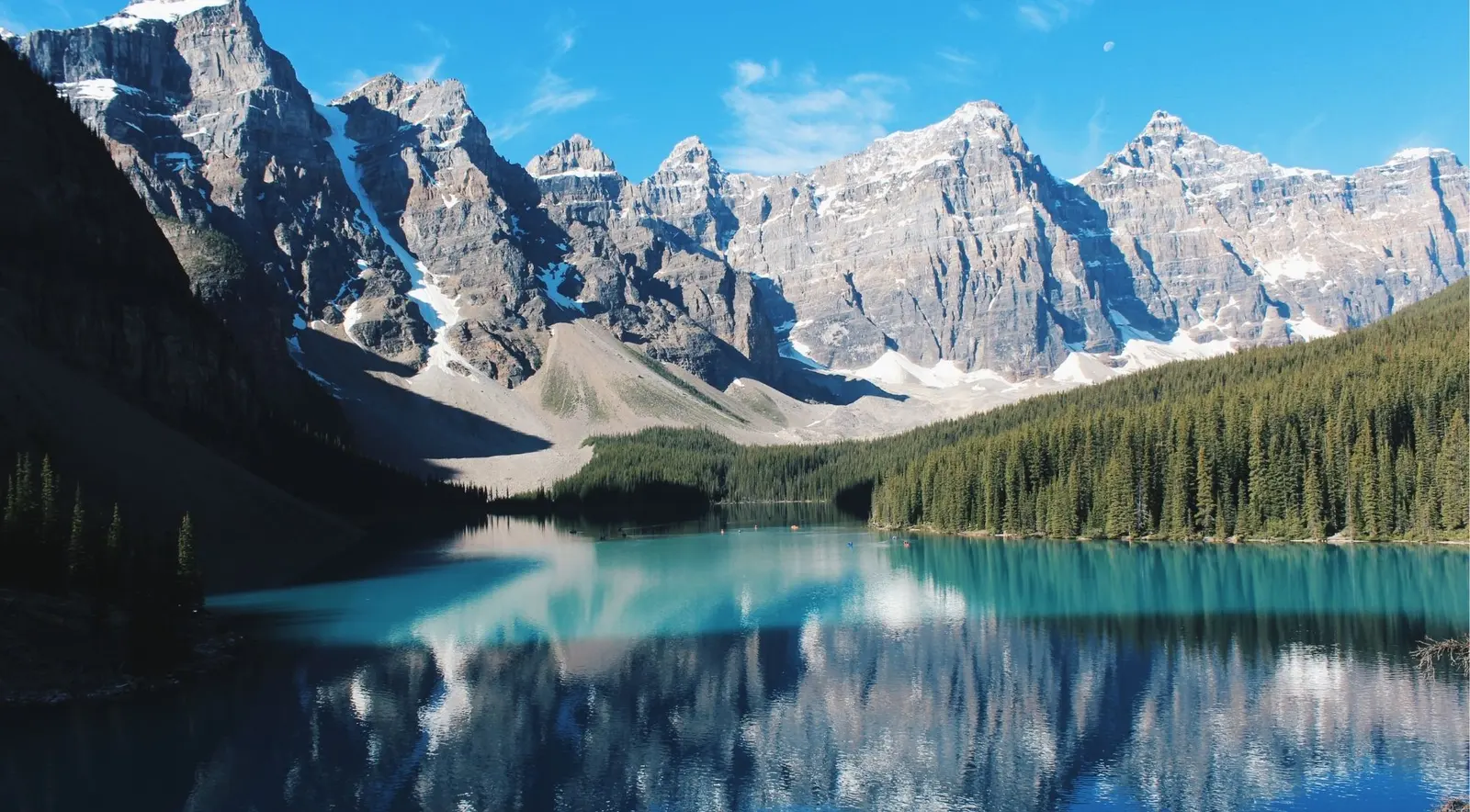
Turquoise Moraine Lake ringed by the Valley of the Ten Peaks in Banff National Park
Moraine Lake · Shuttle & access rules · 2026 guide

Moraine Lake: Shuttle, Access Rules & Wildlife on the Road

You cannot drive to Moraine Lake. Personal vehicles have been banned from Moraine Lake Road year-round since 2023, and in 2026 the road opens June 1 and closes October 12. Every legitimate way in runs through a shuttle, a bus pass, a licensed operator, a bicycle, or a room booking at the lake's one lodge — here's how each one actually works, and why the road runs through core grizzly habitat.

No private vehicles, year-roundRoad open Jun 1–Oct 12, 2026
  • Jun 1–Oct 122026 road season
  • No carsBanned year-round since 2023
  • 1,884 mLake elevation
  • Group of 4Grizzly-season hiking rule
  • $12.75Parks Canada shuttle, adult fare
The first thing to understand

Why You Can't Just Drive There

There is no parking to circle for, no early-alarm advantage, no accessible-placard workaround anymore. Most guides stop at the access rules — but this is a wildlife site, and the more interesting story is why the cars went away: Moraine Lake Road runs straight through core grizzly habitat, and what that means for anyone planning to hike above the lake, where Parks Canada can legally order you to travel in a group of four.

Check live availability and prices on GetYourGuide. Pоwered by GetYourGuide.
Every legitimate way in

The Access Options, In Full

Seven ways to actually reach Moraine Lake in 2026 — and two that don't work at all.

Parks Canada shuttle — the default

Departs the Lake Louise Park & Ride at the ski resort, 1 Whitehorn Road, where parking is free and plentiful. Runs June 1–October 12, roughly every 30 minutes from 6:30am, last return 7:30pm. One ticket includes the Lake Connector between Lake Louise lakeshore and Moraine Lake. Fares: $12.75 adult, $6 senior, $4 youth (17 and under), plus a non-refundable reservation fee ($3.50 online, $5.50 by phone) — your park entry pass is separate. For 2026, reservations opened April 15 at 8:00am MDT for 40% of seats; the remaining 60% drop at 8:00am MDT exactly two days before each departure, at reservation.pc.gc.ca or 1-877-737-3783. There are no walk-up seats. Moraine Lake is treated as backcountry: no cell service, no running water, no Wi-Fi or lighting, pit toilets only, with reception returning about 5km back down the road.

The Alpine Start shuttle — for sunrise

Two early departures daily, 4:00am and 5:00am, aimed at sunrise photographers, climbers and mountaineers. It departs from the Lake Louise lakeshore parking lot (paid, not included in the ticket), not the Park & Ride, and accessible service is not available on it.

Roam Transit — for car-free visitors from Banff

There's no dedicated Roam bus to Moraine Lake, and Roam has confirmed it will not run its old Route 10 in 2026. What works instead is the Reservable Super Pass ($30 adult, $15 youth/senior, under-12s free but still needing a reservation), which bundles a round trip on Route 8X (Lake Louise Express) from Banff plus access to the Lake Connector up to Moraine Lake. The critical rule: you must start your journey in Banff — a Super Pass bought in Lake Louise won't get you there, and walk-up 8X riders don't get Moraine access. Runs June 1–October 12 only; the Lake Connector leg is first-come, first-served.

Licensed commercial shuttles & tours — the guaranteed route

These operators hold a Parks Canada Moraine Lake Road Licence of Occupation and can drive right to the lake, sidestepping the reservation lottery entirely. Per Banff & Lake Louise Tourism they include Moraine Lake Bus Company (pickups from the Lake Louise gondola and Samson Mall; runs sunrise trips), Fairview Limousine (the only Lake Louise-based operator serving both lakes, with sunrise, single-lake and combo options), Lake Louise Shuttle Company, and Mountain Park Transportation (from Banff town). Guided tour operators like Radventures and Discover Banff Tours fold Moraine Lake into multi-stop days with a set window at the lake. Prices vary by operator, season and time of day — sunrise is priciest — so confirm directly.

Cycling

From Lake Louise village it's about 14km one-way with 527m of climbing. The road is narrow with no shoulder and steady commercial traffic, so ride early or late. Rentals, including e-bikes, are at Wilson Mountain Sports in the village. There's a genuine local's window in late May: after the road is plowed but before it opens to buses, cyclists have it car-free.

What doesn't work

Taxis and rideshares can't drop you at the lake — only licence-holding vehicles may drive the road. Walking in is legal but a bad idea: 28km round trip on a narrow road with traffic and no services, and Parks Canada explicitly advises against it.

The Lodge loophole

Registered guests of Moraine Lake Lodge may drive the road — effectively the only private-vehicle access left, at luxury-hotel prices and with bookings that fill a year ahead.

Worth adding to your itinerary

Other Experiences You Might Enjoy

Most visitors pair Moraine Lake with the rest of the Bow Valley.

A Moraine Lake visit pairs naturally with the rest of the Canadian Rockies: a walk along the shore of Lake Louise, a hike through Johnston Canyon, a drive up the Icefields Parkway toward the Columbia Icefield, or a guided wildlife safari out of Banff or Canmore. The live options below update automatically for available experiences in and around Lake Louise, Banff National Park and the Bow Valley.

The part competitors skip

Wildlife on the Road: Why the Cars Went Away

Moraine Lake Road runs directly through one of just three core grizzly areas in Banff National Park — where, in Parks Canada's words, a concentration of female grizzlies live and raise cubs, heavily dependent on buffaloberries. A single grizzly can eat up to 250,000 buffaloberries in a day, and the slopes around this valley are exactly the kind of berry habitat they need. So the interesting question isn't just how to get to the lake — it's whether banning cars actually helped the bears.

Parks Canada's rationale for the 2023 closure explicitly included reducing stress on wildlife using the corridor. The traffic reduction was substantial: per Parks Canada figures reported by Global News, removing personal vehicles cut roughly 900 cars and 20,000 kilometres of driving per day, along with more than four tonnes of daily carbon emissions, and observers report improved wildlife movement through the corridor since. It's fair to call this a plausible, monitored benefit rather than a fully published study — but the logic is sound, and it makes Moraine Lake a rare case where crowd management and conservation pulled in the same direction.

A legal order, not advice

The Grizzly Group-of-Four Rule

Almost no guide explains this properly — here's what every visitor hiking above Moraine Lake needs to know.

On the trails radiating from the single Moraine Lake trailhead — Larch Valley, Sentinel Pass, Eiffel Lake, Wenkchemna Pass, plus nearby Paradise Valley and Consolation Lakes — Parks Canada can impose a mandatory "tight group" restriction during grizzly berry and larch season, historically from about mid-July through mid-October. (The Rockpile viewpoint is not included.) This isn't advice — it's a legal order, issued by the Superintendent under Section 7(1) of the National Parks General Regulations of the Canada National Parks Act. When active, the standard wording requires that all hiking parties travel in a minimum group of four, the maximum distance between any two people is 3 metres, and everyone carries bear spray. Bicycles and dogs are typically banned in the zone while it's in effect, and the bulletin states plainly: violators may be charged, with a maximum penalty of $25,000.

The purpose is twofold — keep people noisy and grouped so bears hear them coming, and avoid displacing grizzlies from prime food at a critical time of year. The minimum group size was actually reduced from six to four in 2007. What this means in practice: if you're a solo hiker or a pair, you team up at the trailhead or you turn back — there's no Parks Canada group-formation service, but hikers just band together, which is easy on trails this popular, or you join a licensed guided group. Staff check compliance on patrol. Two nuances worth knowing: the restriction isn't guaranteed every year at Moraine Lake — it depends on bear activity, and in some seasons it's been "recommended" here while posted as a hard order elsewhere — and because it changes daily, the only authoritative source is the Parks Canada Banff bulletins page, checked the morning of your hike (parks.canada.ca/pn-np/ab/banff/bulletins).
Colour, name, and the $20 bill

The Lake Itself

Moraine Lake sits at 1,884m in the Valley of the Ten Peaks, about 14km by road from Lake Louise village — small (around 50 hectares, 14m deep at most), but famous out of all proportion to its size.

The colour, and when it arrives

Glacial rock flour

The water is fed by snowmelt and glacial melt and doesn't reach its crest until mid-to-late June — only then does it turn the famous azure, coloured by glacial rock flour that scatters blue-green light back at you. In early June the lake may still be partly frozen or a quieter deep blue; it peaks turquoise mid-to-late June through early September and fades a little in October. The water stays 4–5°C all summer.

A name that's technically wrong

Not actually a moraine

American mountaineer Walter Wilcox named the lake in 1899, assuming the natural dam holding the water was a glacial moraine. Geologists later concluded it's actually a rockslide off Mount Babel, dating back around 10,000 years.

The Wenkchemna Peaks

The Ten Peaks

In 1894 the peaks framing the lake were numbered east to west using Stoney Nakoda numerals — Wenkchemna is the Stoney word for "ten." Most were later renamed for individuals, including Mount Fay, Mount Little, Deltaform Mountain and Neptuak.

The Twenty Dollar View

On the back of the $20 bill

Moraine Lake and the Ten Peaks appeared on the back of the Canadian twenty-dollar bill in the 1969–1979 "Scenes of Canada" series. You get the view from the top of the Rockpile Trail, a short but steep 300m climb over the rockslide debris — also a reliable spot for pikas, marmots and ground squirrels.

One of Canada's most sought-after experiences

Sunrise at Moraine Lake

It works differently than you'd expect, and the regular shuttle is too late to catch it in summer.

Because the lake is ringed by tall peaks, golden light hits the water 30–40 minutes after official sunrise. The real magic is the alpenglow — the Ten Peaks turning pink and gold about 20–30 minutes before sunrise. In June, sunrise comes as early as 5:00–5:30am, so aim to be on the Rockpile by 4:15. The regular 6:30am shuttle is too late for June and July sunrise — you need the Alpine Start shuttle or a commercial sunrise operator. Most photographers rate sunrise over sunset here, for softer light and mirror-calm water, and since the last shuttle leaves around 7:30pm, sunset is logistically harder anyway. Crowds still gather on the Rockpile (hundreds in peak season), but the access friction has taken the edge off the old chaos, when people arrived by 2:30am to fight for parking.

From an easy stroll to a strenuous pass

Hikes From Moraine Lake

Six trails from the single trailhead — note which ones fall under the grizzly group-of-four rule when it's active.

TrailDistance & gainDifficultyGroup-of-4 rule
Rockpile Trail1.3km round tripEasy, ~45 minNot required
Shoreline TrailFlat, along the water toward Mount FayEasyNot required
Larch Valley & Sentinel Pass11.6km round trip, 725m gainStrenuous, 4–6 hrsApplies when active
Eiffel Lake11–12km round trip, ~400m gainModerateApplies when active
Wenkchemna Pass18km round trip, 930m gainStrenuousApplies when active
Consolation Lakes6km round trip, from the RockpileEasyWithin bear-management zone

Larch Valley holds one of the most accessible large stands in Banff, which is why it's the most famous larch hike in the Rockies. Larches are deciduous conifers that turn brilliant gold and drop their needles each autumn; the gold runs mid-September to early October, a two-to-three-week window, with the last two weeks of September the safe bet. Crucially, larch season overlaps the grizzly group-of-four window — if you're hiking Larch Valley in late September, plan to be in a group and carry bear spray. Crowds are extreme, and the shuttle for those dates sells out fastest of any time in the season.

Skip the reservation lottery entirely

A Licensed Shuttle Sidesteps the Whole Booking Problem

Highest-rated pick on this page — sells out its Parks Canada seats fastest of any option, so a licensed operator is the reliable backup.

Best value · 1,226 reviews

Banff Lake Louise & Moraine Lake 1.5hr Half Day Shuttle Tour

From $59★ 4.9 (1,226 reviews)Free 24-hour cancellation

Departs Canmore or Banff and gives you 1 hour 15 minutes at Lake Louise plus 1.5 hours at Moraine Lake, holding a Parks Canada Licence of Occupation so it drives straight to the lake — no reservation lottery. Outside its own listed Moraine Lake window (June 1–October 11) it substitutes Johnston Canyon.

Check availability & prices

Free cancellation. Sidesteps the shuttle lottery. Secure booking via GetYourGuide.

Two updates worth knowing before you go

What Changed for 2026

No more paddling

Moraine Lake is now a designated Water Preservation Zone, and paddling of any kind is banned — canoes, kayaks, paddleboards, all of it. The measure protects against whirling disease (confirmed in nearby Lake Louise in 2025) and aquatic invasives. The Moraine Lake Lodge canoe rental has stopped, and you can't bring your own watercraft. Paddling remains fine at Lake Louise, Two Jack Lake and Vermilion Lakes.

Accessibility got harder

The accessible-parking-placard exception that once let disabled visitors drive the road has been removed for 2026. Parks Canada's substitute is a new on-demand accessible shuttle: buy a regular shuttle ticket, tell on-site staff your needs (no advance registration), and an accessible vehicle is dispatched, with a companion allowed if space permits, 6:30am–7:30pm from June 1. The Alpine Start is not accessible. Some stale Parks Canada pages and many travel blogs still cite the old placard exception — the 2026 removal is authoritative but not universally reflected online, so confirm current arrangements before travelling.

What to expect once you're there

Season & Facilities

The road opens June 1 and closes October 12 for 2026, weather permitting — it opens late because it crosses avalanche paths and must be cleared and assessed, and the lake at 1,884m can stay frozen into early June. In winter the road is closed to vehicles, though ski-tourers and snowshoers with avalanche training use the corridor; Lake Louise, by contrast, is accessible year-round. At the lake: pit toilets, no running water, no cell service, no Wi-Fi. Moraine Lake Lodge has a café and boutique open to the public, but it may not open until ~8am, so sunrise visitors should bring breakfast and water. At nearly 1,900m it's markedly colder than Banff town — even July mornings can be near-freezing at the shoreline, so dress in warm layers year-round. The Rockpile has stairs and isn't wheelchair-friendly, and there's no dedicated accessible viewpoint at lake level.

Common questions

Moraine Lake: FAQs

The questions travellers ask most before planning a Moraine Lake visit.

Can you drive to Moraine Lake?

No. Personal vehicles are banned year-round, including for accessible-placard holders as of 2026. Access is by Parks Canada shuttle, Roam Super Pass from Banff, licensed commercial shuttle or tour, bicycle, or as a registered Moraine Lake Lodge guest.

How do I get to Moraine Lake from Banff?

Buy a Roam Reservable Super Pass, which combines the 8X bus from Banff with the Lake Connector up to Moraine Lake — you must start your journey in Banff. Alternatively, book a commercial shuttle or guided tour that includes hotel pickup.

When does Moraine Lake turn blue?

The vivid turquoise arrives mid-to-late June as the lake fills with glacial melt, peaks July through early September, and fades slightly in October. In early June it may still be partly frozen.

When is Moraine Lake Road open in 2026?

June 1 to October 12, weather permitting. It's closed to vehicles the rest of the year.

How hard is it to book the Moraine Lake shuttle?

Hard in summer. Reservations opened April 15, 2026, for 40% of seats; the other 60% release two days before each departure at 8:00am MDT. There are no walk-up seats, and morning slots sell out fastest — have a commercial shuttle as backup.

Is sunrise at Moraine Lake worth it?

Most photographers think so — softer light, calm water, alpenglow on the peaks. You need the Alpine Start shuttle or a commercial sunrise trip, as the regular shuttle is too late for summer sunrise.

Can I canoe at Moraine Lake?

No longer. Paddling was banned for 2026 to protect against whirling disease. Try Lake Louise, Two Jack Lake or Vermilion Lakes instead.

Do I need to hike in a group at Moraine Lake?

On the Rockpile, no. On Larch Valley, Sentinel Pass, Eiffel Lake and Wenkchemna Pass, Parks Canada may require groups of four or more during bear season, enforceable by fine. Check the Banff bulletins page the morning of your hike. For the bigger picture on bear safety, see our bear watching guide.

Planning a visit?

Sort Your Access First — Then Chase the Light

Book the moment your Parks Canada window opens, with a commercial shuttle as backup. Target late June to early September for peak colour, or the last two weeks of September for larches (booking earliest of all). And if you're hiking above the lake, check the bear bulletin and be ready to group up.

  • Licensed shuttles skip the reservation lottery entirely
  • Sunrise needs the Alpine Start or a commercial operator
  • Free cancellation on most tours — book with confidence
Check Moraine Lake Shuttle Availability

We may earn a commission from bookings made through our links, at no extra cost to you. See our affiliate disclosure. Or browse our Banff tours guide for how Moraine Lake fits the wider tour market.